


Photo by NastyaSensei via Pexels
Introduction: The New Cold War Playing Out in Silicon and Software
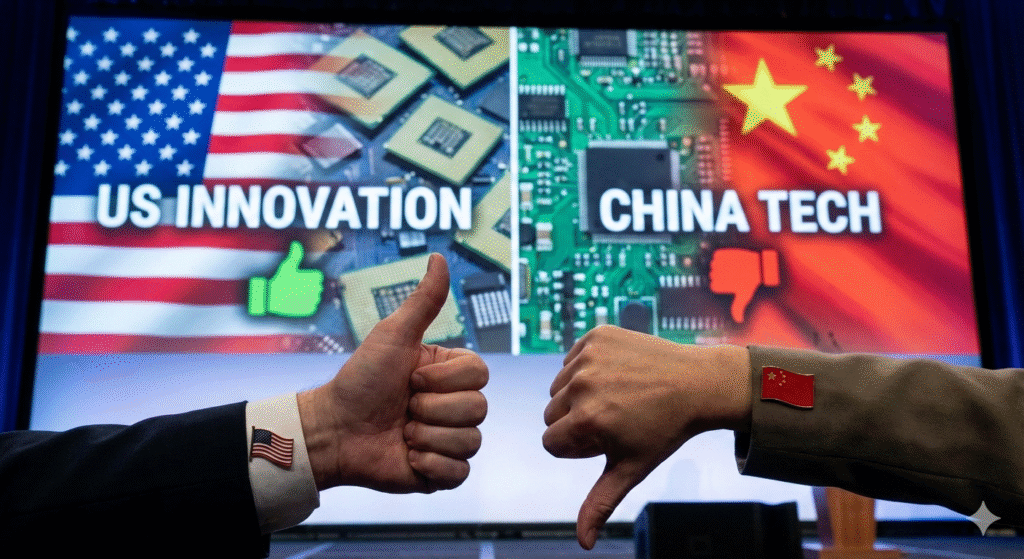
The US-China technology rivalry has intensified dramatically in 2025, evolving from trade disputes into comprehensive competition for technological supremacy. From semiconductor restrictions to AI development, the world’s two largest economies are locked in an “AI Cold War” with profound implications for global innovation and economic growth.
The 2025 Technology Battleground: Key Conflict Areas
1. Semiconductor Supremacy: The Foundation of Tech Power
US Export Controls Tighten:
- Advanced chip manufacturing equipment (EUV lithography) banned
- AI-capable GPU exports heavily restricted
- Design software and EDA tools require licenses
- Outbound investment screening for US capital in Chinese semiconductor firms
China’s Response:
- $150+ billion committed to domestic chip production
- Rare earth export restrictions (gallium, germanium, graphite)
- Focus on alternative architectures (chiplets, 3D integration)
2. Artificial Intelligence: The Strategic Technology Race
DeepSeek’s January 2025 Breakthrough:
China’s DeepSeek released an LLM achieving GPT-4-comparable performance using significantly fewer computational resources, demonstrating Chinese AI capabilities advancing despite semiconductor restrictions.
US AI Leadership Strategy:
- Export controls preventing adversary AI advancement
- OpenAI’s $38 billion AWS agreement for massive capacity
- Anthropic’s $50 billion U.S. data center buildout
Domestic Debates in China: Economic “Involution”
Chinese domestic debates reveal concern about economic “involution”—cutthroat competition and unsustainable price wars driven by overcapacity.
Manifestations:
- E-commerce platforms in subsidy-driven price wars
- Local governments racing to subsidize same industries
- Companies tolerating losses for market share
Geopolitical Connection: With US tariffs threatening exports, Beijing recognizes that economic “involution” risks weakening China’s global competitiveness.
Global Impact: Technology Markets Fracture
The Emerging Bipolar Technology World
Western Ecosystem:
- US cloud platforms (AWS, Azure, Google Cloud)
- American AI models (OpenAI, Anthropic, Google)
- Allied semiconductor supply chains
Chinese Ecosystem:
- Chinese cloud platforms (Alibaba, Huawei)
- Domestic AI models (DeepSeek, Baidu, Alibaba)
- Alternative standards and protocols
Implications: Multinational corporations face impossible compliance choices as ecosystems diverge.
2026 Outlook: What to Expect Next
Base Case (60% Probability): Managed Competition
- Continued tensions without catastrophic escalation
- Strategic decoupling in critical technologies continues
- Trade remains substantial despite restrictions
Escalation Scenario (25% Probability)
- Taiwan contingency triggering comprehensive sanctions
- Complete technology decoupling
- Economic disruption at pandemic scale
Conclusion: Technology Competition Reshaping Global Order
The US-China technology war has transcended trade policy to become a defining feature of 21st-century geopolitics. As both nations pursue technological self-sufficiency, the global technology landscape is fracturing into competing ecosystems.
Organizations must redesign supply chains with geopolitical resilience, develop scenario planning for multiple futures, and adapt to increasing compliance burdens as regulations proliferate.
Sources: Merics, Atlantic Council, ITIF, Wall Street Journal, AEI, El País