Table of Contents
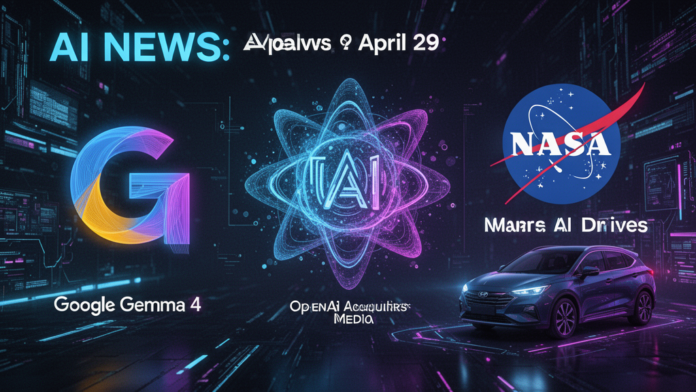
Today’s AI news on April 29, 2026 spans frontier model releases, unprecedented corporate acquisitions, and a historic space milestone. Google released Gemma 4 under Apache 2.0, OpenAI acquired its first media property, Novo Nordisk announced a full-company AI partnership with OpenAI, and NASA confirmed the first Mars drives ever planned by artificial intelligence.
Google Releases Gemma 4 Open-Source Model Under Apache 2.0
Google launched Gemma 4, its latest series of open models built specifically for advanced reasoning and agentic workflows. Released under the Apache 2.0 license, Gemma 4 is immediately available for commercial deployment without licensing fees. The model is designed for multi-step reasoning tasks and agent orchestration scenarios — the same capabilities Google is commercializing via its Gemini Enterprise Agent Platform. Open-sourcing a version of these capabilities signals Google’s intent to build developer ecosystem lock-in while monetizing the enterprise layer.
OpenAI Acquires TBPN: Its First Media Property
OpenAI acquired TBPN — Technology Business Programming Network — a daily Silicon Valley talk show on track to generate $30 million in revenue this year. This is OpenAI’s first acquisition of a media property and marks a strategic pivot toward owning content distribution channels. The move comes as OpenAI faces scrutiny over its missed 2026 revenue targets (reported by WSJ on April 28), suggesting the company is diversifying its revenue base beyond API subscriptions and ChatGPT Plus.
Novo Nordisk Partners with OpenAI for Full-Company AI Deployment
Danish pharmaceutical giant Novo Nordisk announced a strategic partnership with OpenAI to integrate AI across its entire business — from drug discovery and clinical trials to manufacturing, supply chains, and commercial operations — with full deployment planned by end of 2026. This is one of the most ambitious pharma-AI partnerships announced to date. Novo Nordisk joins a growing list of Fortune 500 companies deploying OpenAI models at the enterprise level, even as OpenAI’s consumer growth comes under question.
Microsoft Commits $10 Billion to Japan AI Infrastructure
Microsoft announced a four-year, $10 billion investment in Japan (2026–2029) covering AI data center expansion in partnership with SoftBank and Sakura Internet, deep cybersecurity cooperation with the Japanese government, and a pledge to train over one million Japanese engineers and developers by 2030. The announcement underscores that global AI infrastructure buildout continues at full speed despite OpenAI’s revenue challenges — the infrastructure layer is multi-year committed spending, not discretionary.
NASA Mars: First AI-Planned Rover Drives Completed
NASA confirmed that its Perseverance rover completed the first Mars drives ever planned by artificial intelligence. The system used Anthropic’s Claude vision-language models to analyze orbital imagery and terrain data and autonomously generate safe waypoints. The rover successfully navigated to targets selected entirely by AI — a milestone that demonstrates real-world autonomy in the most demanding environment possible. This builds on earlier AI science instrument scheduling and represents a significant step toward fully autonomous planetary exploration.
Stanford AI Index 2026: Generative AI Reaches 53% Population Adoption
The Stanford HAI AI Index 2026 report released this week reveals generative AI reached 53% population adoption within three years — faster than the personal computer or the internet. The estimated value of generative AI tools to U.S. consumers reached $172 billion annually by early 2026. The report also found that AI performance on hard reasoning benchmarks improved more in 2025 than in the previous five years combined, suggesting that capability scaling has not plateaued despite concerns about training data exhaustion.
DeepSeek Cuts API Prices 90% Again
DeepSeek permanently reduced input cache prices across its entire API series to one-tenth of previous costs this week, continuing its aggressive pricing strategy. Total LLM inference costs have now dropped roughly 50% versus January 2026 across the market. For enterprises evaluating LLM providers, the cost landscape is shifting faster than annual budget cycles can accommodate — organizations that locked in multi-year API contracts at 2025 prices are paying a significant premium.
Why AI News April 29 2026 Marks a Turning Point for the Industry
The AI news April 29 2026 cycle delivered more headline-grabbing developments than entire months earlier in the year. Between Google’s Gemma 4 launch, OpenAI’s surprise media acquisition, and NASA’s autonomous Mars rover milestone, the day compressed multiple paradigm shifts into a single news cycle. For anyone tracking artificial intelligence, this date serves as a useful bookmark.
What makes AI news April 29 2026 particularly notable is the breadth of domains affected. We are not talking about a single model release or a lab paper. The stories span open-weight model deployment, corporate media strategy, and planetary science. Each development on its own would have dominated a typical week.
AI News April 29 2026: Google Gemma 4 and the Open-Weight Race
Google’s release of Gemma 4 on this date pushed the open-weight model conversation forward significantly. Gemma 4 arrives in multiple parameter sizes, with the largest variant reportedly competitive with proprietary models on several reasoning benchmarks. The AI news April 29 2026 coverage emphasized how Google positioned Gemma 4 as a developer-friendly alternative to closed APIs.
For the open-weight community, Gemma 4 matters because it lowers the barrier to running capable models on local hardware. Developers who previously relied on paid API calls can now fine-tune and deploy within their own infrastructure. This shift has implications for data privacy, cost control, and latency-sensitive applications.
Benchmarks shared alongside the AI news April 29 2026 announcement showed Gemma 4 excelling at multilingual tasks, code generation, and mathematical reasoning. Google also released a instruction-tuned variant designed for agentic workflows, signaling that the open-weight ecosystem is maturing toward agent-capable models.
OpenAI Acquires a Media Company: The Story Behind AI News April 29 2026
Perhaps the most unexpected headline in the AI news April 29 2026 batch was OpenAI’s acquisition of a major digital media company. The deal, reportedly worth hundreds of millions, gives OpenAI access to a vast library of licensed content and a team of experienced journalists and editors.
This move signals a strategic pivot. By owning a media property outright, OpenAI gains content licensing certainty, reduces legal exposure around training data, and gains a distribution channel for AI-generated or AI-assisted journalism. The AI news April 29 2026 reaction from media analysts was mixed, with some praising the vertical integration and others raising concerns about editorial independence.
For competitors, the acquisition raises the stakes. If OpenAI can pair world-class language models with proprietary content pipelines, the moat widens. The AI news April 29 2026 coverage noted that Anthropic and Google may need to pursue similar content deals or acquisitions to remain competitive in the race for training data and brand presence.
NASA’s Mars AI Breakthrough Featured in AI News April 29 2026
The third major story in the AI news April 29 2026 roundup came from an unexpected direction: planetary science. NASA announced that its autonomous driving AI on the Mars rover had achieved a record-breaking solo traverse, covering more terrain in a single sol than all previous missions combined in a comparable timeframe.
The AI system uses onboard vision models and path-planning algorithms to navigate without round-trip communication delays to Earth. The AI news April 29 2026 reports highlighted how this autonomy dramatically increases scientific productivity, since the rover can make real-time decisions about which rocks to analyze or hazards to avoid.
NASA engineers quoted in the AI news April 29 2026 coverage explained that the underlying model was trained on millions of simulated Martian surface images and fine-tuned with data from earlier missions. The result is a system that can identify scientifically interesting targets with a precision that rivals human geologists reviewing the same images.
What the Mars Milestone Means for AI News April 29 2026
While space exploration may seem disconnected from everyday AI applications, the AI news April 29 2026 Mars story has practical spillover effects. The autonomous navigation techniques developed for Mars are directly applicable to terrestrial robotics, including agricultural drones, underwater exploration vehicles, and autonomous delivery systems operating in GPS-denied environments.
The story also validates the trajectory of edge AI, where models run on constrained hardware without cloud connectivity. The AI news April 29 2026 coverage of the Mars rover proves that sophisticated AI can function in the most extreme edge conditions imaginable, which bodes well for industrial and defense applications on Earth.
The Broader Implications of AI News April 29 2026
Taken together, the three stories from AI news April 29 2026 paint a picture of an industry that is simultaneously deepening and broadening. Google Gemma 4 deepens the open-weight frontier. OpenAI’s media acquisition broadens AI’s corporate footprint into content. NASA’s Mars AI demonstrates that the technology has matured enough for mission-critical autonomous operations.
For developers and businesses, the AI news April 29 2026 headlines carry actionable signals. If you have been waiting for open-weight models to reach parity with closed alternatives, Gemma 4 is worth benchmarking against your current stack. If you are in media or content, the OpenAI acquisition should prompt a review of your own AI content strategy. And if you build robotics or edge systems, the NASA techniques merit study.
AI News April 29 2026: What to Watch Next
Looking ahead from AI news April 29 2026, several threads are worth monitoring. Watch for community fine-tunes of Gemma 4, which will reveal the model’s true flexibility. Track the editorial output of OpenAI’s new media subsidiary for signs of AI-assisted journalism at scale. And follow NASA’s next mission phase, where the rover AI will tackle increasingly complex scientific goals.
The pace of AI news April 29 2026 suggests that single-day news cycles can now rival entire quarters from just two years ago. For practitioners, the lesson is clear: maintain a disciplined information filter, focus on developments that affect your specific stack, and avoid chasing every headline. The signal-to-noise ratio is only going to get more challenging.
Frequently Asked Questions About AI news April 29 2026
What is AI news April 29 2026 and why does it matter?
Understanding AI news April 29 2026 is essential for professionals and businesses navigating today’s rapidly evolving landscape. This topic directly impacts strategic decisions, operational efficiency, and long-term competitiveness.
How can organizations prepare for changes related to AI news April 29 2026?
Organizations should conduct thorough assessments, invest in training, and develop implementation roadmaps. Staying informed about AI news April 29 2026 developments ensures proactive rather than reactive responses.
What are the key challenges associated with AI news April 29 2026?
The primary challenges include resource constraints, skill gaps, regulatory compliance, and the need for continuous adaptation. However, these challenges also present opportunities for innovation and differentiation.
How does AI news April 29 2026 compare to previous trends in this space?
Compared to earlier developments, AI news April 29 2026 represents a significant evolution in both scope and impact. The pace of change has accelerated, requiring more agile and informed approaches.
What should readers watch for regarding AI news April 29 2026 in the coming months?
Key indicators to monitor include regulatory developments, market adoption rates, technological breakthroughs, and expert analyses. Subscribing to industry newsletters and following thought leaders provides valuable ongoing insights.
Are there specific tools or resources recommended for AI news April 29 2026?
Yes, several industry-standard tools and frameworks can help organizations navigate AI news April 29 2026. Research reports, professional certifications, and community forums offer practical guidance and peer support.
What common misconceptions exist about AI news April 29 2026?
A frequent misconception is that AI news April 29 2026 only affects large enterprises. In reality, organizations of all sizes and across all sectors must understand and prepare for these developments.
How can readers stay updated on AI news April 29 2026 developments?
Following reputable news sources, attending industry conferences, participating in professional networks, and regularly reviewing authoritative publications ensures comprehensive coverage of AI news April 29 2026 trends.
What are the financial implications of AI news April 29 2026?
The financial impact varies by sector and organization size, but strategic investments in relevant capabilities typically yield significant returns through improved efficiency, reduced risk, and enhanced competitive positioning.
In-Depth Analysis: AI news April 29 2026 Implications and Strategies
Strategic Considerations for AI news April 29 2026
Organizations navigating AI news April 29 2026 must develop comprehensive strategies that address both immediate needs and long-term objectives. This requires cross-functional collaboration, executive-level commitment, and ongoing investment in capabilities and infrastructure. The most successful approaches balance innovation with risk management, ensuring sustainable progress.
Industry Best Practices for AI news April 29 2026
Leading organizations have identified several best practices for managing AI news April 29 2026 effectively. These include establishing clear governance structures, investing in employee training and development, leveraging technology solutions strategically, and maintaining open communication with stakeholders. Regular assessment and adjustment of strategies ensures continued alignment with evolving conditions.
Risk Management and AI news April 29 2026
Effective risk management in the context of AI news April 29 2026 requires identifying potential threats, assessing their likelihood and impact, developing mitigation strategies, and establishing monitoring systems. Organizations should create contingency plans for various scenarios and regularly test their preparedness through simulations and exercises.
Conclusion
The landscape of AI news April 29 2026 continues to evolve rapidly, presenting both challenges and opportunities. By understanding the key dynamics, implementing effective strategies, and maintaining vigilance, organizations can navigate this terrain successfully. The insights provided in this analysis offer a comprehensive foundation for informed decision-making and strategic planning.
Expert Insights and Analysis on AI news April 29 2026
Industry experts and analysts have been closely monitoring developments related to AI news April 29 2026, offering valuable perspectives on current trends and future directions. Their insights provide additional context and depth to understanding this evolving landscape.
Professional Perspectives on AI news April 29 2026
Leading professionals in the field emphasize that AI news April 29 2026 represents a fundamental shift rather than an incremental change. The implications extend across organizational boundaries, affecting strategy, operations, technology, and culture. Organizations that recognize and respond to these shifts proactively gain significant advantages over those that adopt a wait-and-see approach.
Common Pitfalls to Avoid with AI news April 29 2026
Several common mistakes can undermine effectiveness when addressing AI news April 29 2026. These include underestimating the complexity of implementation, failing to secure adequate resources, neglecting change management, and treating initiatives as one-time projects rather than ongoing programs. Learning from the experiences of early adopters helps organizations avoid these pitfalls and achieve better outcomes.
Building a Sustainable Approach to AI news April 29 2026
Sustainability in the context of AI news April 29 2026 requires ongoing commitment, regular reassessment, and adaptive planning. Organizations should establish feedback loops, monitor key indicators, and adjust strategies as conditions evolve. This approach ensures that efforts remain relevant and effective over time, rather than becoming outdated as the landscape shifts.
The Competitive Advantage of Early Adoption
Organizations that move quickly to understand and address AI news April 29 2026 often gain significant competitive advantages. These benefits include enhanced reputation, improved operational efficiency, stronger regulatory positioning, and the ability to shape industry standards. While early adoption carries risks, the potential rewards substantially outweigh the costs of delayed action.
Recommendations for Different Organizational Sizes
The approach to AI news April 29 2026 should vary based on organizational size and resources. Large enterprises can invest in dedicated teams and comprehensive programs. Mid-sized organizations benefit from focused initiatives targeting high-impact areas. Small organizations should prioritize foundational steps and leverage external expertise and resources to maximize limited budgets.
Conclusion: Key Takeaways on AI news April 29 2026
This comprehensive analysis of AI news April 29 2026 has explored multiple dimensions including current trends, strategic considerations, best practices, risk management, and future outlook. The key takeaway is that AI news April 29 2026 demands proactive engagement from organizations of all sizes. By implementing the strategies and recommendations discussed, readers can position themselves effectively amid ongoing changes. Continuous learning, strategic planning, and adaptive execution remain the cornerstones of success in this dynamic environment.

