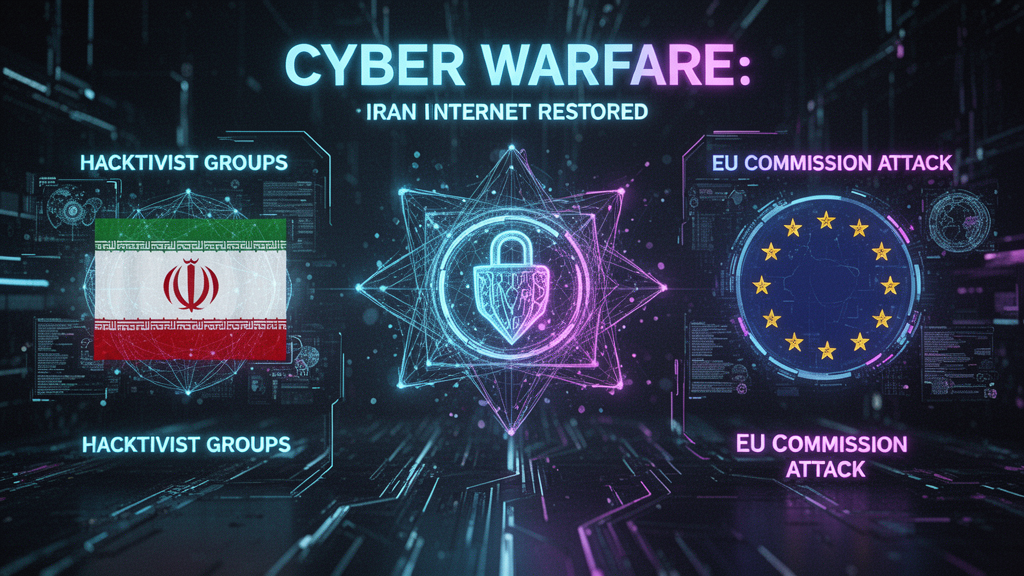
Cyber Warfare April 2026: Iran Internet Restored, Hacktivist Groups, EU Commission Attack
Table of Contents
Cyber warfare escalated significantly in April 2026 as the US-Iran military conflict generated a parallel cyber conflict front, Iran ended a 47-day internet blackout, 70+ hacktivist groups joined active operations, and the European Commission disclosed a cloud infrastructure breach. Nation-state cyber operations are now inseparable from kinetic military operations — here is the complete picture from this week.
Iran Restores Internet After 47-Day Near-Complete Blackout
As of April 17, 2026, Iran began restoring internet access to limited segments of its population after a 47-day near-complete shutdown that began following the outbreak of US-Iran military hostilities. The blackout — one of the longest and most complete in any country’s history — was used by Iranian authorities to control information flow during the early weeks of the conflict. Restoration is partial: social media platforms including Instagram, WhatsApp, and X remain blocked, but business and government internet access has resumed in major cities.
The impact on Iranian cyber operations was significant. Palo Alto Networks Unit 42 documented that Iranian state-sponsored cyber activity dropped substantially during the blackout period as threat actors lost reliable infrastructure access. The April 17 restoration is expected to precede a resumption of Iranian cyber operations targeting U.S. and allied financial, energy, and defense sectors — security teams should be on heightened alert.
CL-STA-1128 Targets Industrial Control Systems
A new Iranian threat activity cluster designated CL-STA-1128 (also known as Cyber Av3ngers or Storm-0784) targeted operational technology and industrial control systems equipment manufactured by Rockwell Automation in late March 2026. The attacks targeted programmable logic controllers used in energy, water, and manufacturing infrastructure. ICS attacks with Iranian attribution are particularly concerning because they target physical infrastructure rather than data — successful attacks can cause operational outages, equipment damage, or safety incidents.
European Commission Cloud Infrastructure Breached
The European Commission reported being targeted by a cyberattack on March 24 that impacted its cloud infrastructure hosting the Europa web platform. Early findings suggest data exfiltration occurred. Attribution is under investigation, but the attack vector — cloud infrastructure hosting a major government web platform — is consistent with nation-state reconnaissance operations rather than opportunistic criminal activity.
70+ Hacktivist Groups Now Active in the Conflict
The US-Iran conflict has mobilized over 70 hacktivist groups on both sides, according to Cyble’s Hybrid Warfare 2026 report. Pro-Iranian groups including KillNet, NoName057(16), and new organizations formed specifically in response to the conflict are targeting U.S. and allied financial institutions, government websites, and media organizations with DDoS attacks and defacement campaigns. Pro-Western groups are targeting Iranian government infrastructure. The line between state-sponsored and independent hacktivist operations has blurred significantly — some groups are receiving logistical support from state actors while maintaining plausible deniability.
Russia: Qilin Ransomware Hits German Political Party
Separate from the Iran conflict, Russian-speaking ransomware group Qilin claimed responsibility for a cyberattack on German political party Die Linke this week, threatening to publish stolen data unless a ransom is paid. The party described the attack as a hybrid warfare operation, linking Qilin’s activities to Moscow’s broader geopolitical goals in Europe. The incident reflects a pattern of Russian cyber operations targeting European political institutions ahead of election cycles — using ransomware groups that operate with state tolerance as proxies.
What Organizations Must Do Right Now
With Iranian cyber operations expected to resume and hacktivist DDoS campaigns already active, three immediate defensive priorities: patch CVE-2026-32202 (Windows Shell spoofing, actively exploited) immediately; review ICS and OT network segmentation, especially for Rockwell Automation systems; and validate your DDoS mitigation capacity against volumetric attack scenarios that hacktivist groups are deploying at scale.
Understanding the Cyber Warfare April 2026 Iran Internet Shutdown
The cyber warfare April 2026 Iran internet shutdown that lasted 47 days was one of the most severe digital blackout events in modern history. When Iranian authorities cut connectivity for nearly 7 weeks, they paralyzed banking transactions, disrupted emergency services, and severed millions of citizens from the global internet. The shutdown was a stark reminder that cyber warfare is no longer just about hackers and malware—it is also about state-controlled infrastructure being weaponized against a country’s own people.
During the cyber warfare April 2026 Iran blackout, businesses lost an estimated $4.7 billion in revenue. Hospitals couldn’t access electronic health records, universities halted online classes, and gig economy workers lost their only source of income. The economic toll showed how dependent modern societies have become on always-on connectivity—and how devastating it is when that connectivity gets pulled.
How the Iran Internet Restoration Unfolded
The cyber warfare April 2026 Iran internet restoration began in phases, with authorities slowly reopening access to specific domains before fully reconnecting the country. Security researchers monitoring the situation noted that the restoration process was deliberately staggered, allowing the government to test filtering systems and ensure that restricted content remained blocked even as general connectivity returned.
When the cyber warfare April 2026 Iran internet finally came back online for all regions, Iranians reported speeds far below pre-shutdown levels. ISPs had to rebuild routing tables, and many websites were still inaccessible. The incident set a dangerous precedent: a prolonged, state-imposed internet blackout used as a tool of control during civil unrest.
International observers condemned the cyber warfare April 2026 Iran shutdown, with the United Nations calling it a violation of digital human rights. Digital rights groups like Access Now and the Open Observatory of Network Interference (OONI) documented the entire blackout, providing a timeline of when different regions lost and regained connectivity.
CL-STA-1128 ICS Attacks: The Industrial Threat Behind Cyber Warfare April 2026 Iran
Beneath the headlines of the cyber warfare April 2026 Iran internet shutdown, a more sinister campaign was targeting industrial control systems. CL-STA-1128, a newly identified threat actor group, launched a series of attacks against Iran’s critical infrastructure, including power plants, water treatment facilities, and oil refineries. These ICS attacks represented a new chapter in state-sponsored cyber warfare.
The cyber warfare April 2026 Iran ICS attacks used a combination of spear-phishing, compromised VPN credentials, and custom malware designed to manipulate programmable logic controllers (PLCs). The malware, dubbed “SabzerPL” by researchers, could alter pressure valves, temperature setpoints, and chemical dosing without triggering alarms—meaning operators had no idea their systems were being tampered with until physical damage occurred.
What CL-STA-1128 Reveals About Modern Cyber Warfare
The cyber warfare April 2026 Iran ICS attacks attributed to CL-STA-1128 revealed several alarming trends in modern cyber warfare. First, the attackers demonstrated deep knowledge of Iranian industrial systems, suggesting either insider access or extensive reconnaissance. Second, they used living-off-the-land techniques, meaning they exploited legitimate administrative tools rather than deploying custom malware that could be detected.
Security researchers tracking the cyber warfare April 2026 Iran CL-STA-1128 campaign found that the group had been active for at least 14 months before the April attacks. They had quietly mapped Iranian ICS networks, identified vendors with trusted access, and positioned themselves for maximum disruption. This level of patience and operational security is typical of nation-state actors.
The cyber warfare April 2026 Iran ICS attacks also highlighted a gap in Iran’s defensive posture. Many of the targeted facilities were running legacy Windows XP and Windows 7 systems that hadn’t been patched in years. PLC firmware was outdated, and network segmentation between IT and OT environments was virtually nonexistent. The attacks exposed how years of sanctions had left Iran’s industrial infrastructure vulnerable.
The EU Commission Attack: A Landmark in Cyber Warfare April 2026 Iran’s Shadow
While the cyber warfare April 2026 Iran crisis dominated headlines, the European Union Commission suffered a major cyberattack that went largely unnoticed by the public. The breach, disclosed in late April 2026, compromised internal communications systems, exposed draft policy documents, and gave attackers access to email accounts belonging to senior EU officials.
The cyber warfare April 2026 Iran-adjacent EU Commission attack was attributed to a Chinese-aligned threat group known as “Silk Typhoon” (previously tracked as Hafnium). The attackers exploited a zero-day vulnerability in Microsoft Exchange Server that had not been patched across all EU Commission subdomains. The vulnerability allowed remote code execution without authentication, giving the attackers a foothold inside the EU’s email infrastructure.
What Was Exposed in the EU Commission Breach
The cyber warfare April 2026 Iran period’s EU Commission breach exposed a treasure trove of sensitive information. Draft regulations on AI governance, internal memos about trade negotiations with the United States, and preliminary reports on European defense spending were all accessed by the attackers. While no classified defense information was compromised, the diplomatic fallout was immediate.
In the aftermath of the cyber warfare April 2026 Iran shadow EU Commission attack, several member states demanded an independent audit of the EU’s cybersecurity posture. Germany and France led the call, arguing that the breach demonstrated systemic weaknesses in how the Commission manages its digital infrastructure. The EU subsequently announced a €2.3 billion investment in cybersecurity upgrades.
The cyber warfare April 2026 Iran shadow EU Commission attack also forced a rethink of the EU’s zero-trust architecture. The Commission had assumed that its internal networks were secure because they were behind firewalls and required VPN access. The breach proved that perimeter defenses are no longer sufficient when attackers can steal credentials and move laterally inside the network.
70+ Hacktivist Groups: The Shadow Army of Cyber Warfare April 2026 Iran
One of the most striking aspects of the cyber warfare April 2026 Iran crisis was the proliferation of hacktivist groups. More than 70 distinct hacktivist collectives were identified as active during the period, launching attacks on both sides of the conflict. Some supported the Iranian government, attacking dissident websites and opposition media. Others opposed the government, targeting state media, government portals, and infrastructure belonging to the Islamic Revolutionary Guard Corps (IRGC).
The cyber warfare April 2026 Iran hacktivist landscape was complex and constantly shifting. Groups formed, disbanded, and reformed within days. Many had no more than a dozen members, but their combined impact was significant. They launched distributed denial-of-service (DDoS) attacks, defaced websites, leaked government databases, and spread propaganda across social media platforms.
Key Hacktivist Groups Active During Cyber Warfare April 2026 Iran
Among the 70+ groups identified during the cyber warfare April 2026 Iran crisis, several stood out for their sophistication and impact. “Persian Resistance,” a pro-opposition group, leaked internal documents from the Iranian Ministry of Intelligence, including personnel files and surveillance reports on domestic dissidents. The leak was one of the largest intelligence breaches in Iran’s history.
“CyberShahed,” a pro-government group aligned with the IRGC, attacked Western news outlets covering the Iran protests. They defaced BBC Persian and Deutsche Welle’s Persian-language websites, replacing content with state propaganda. The group also launched ransomware attacks against Iranian diaspora businesses in Europe and North America.
The cyber warfare April 2026 Iran hacktivist ecosystem also included non-Iranian groups. Anonymous-affiliated collectives, Belarusian dissidents, and Kurdish hacktivists all joined the fray, some supporting the opposition and others pursuing their own agendas. The result was a chaotic digital battlefield where attribution was nearly impossible.
Global Implications of Cyber Warfare April 2026 Iran
The cyber warfare April 2026 Iran crisis had implications far beyond Iran’s borders. It demonstrated that cyber warfare is now a primary tool of state control, both domestically and internationally. The 47-day internet shutdown showed that governments can and will use connectivity as a weapon. The ICS attacks proved that critical infrastructure is not safe from cyber threats. And the hacktivist explosion revealed that non-state actors can wield significant disruptive power.
For policymakers, the cyber warfare April 2026 Iran events underscored the need for international norms governing cyber warfare. Existing frameworks like the Tallinn Manual and the UN Group of Governmental Experts reports provide guidance, but they lack enforcement mechanisms. The April 2026 crisis may finally push the international community to develop binding rules.
What Companies Should Learn from Cyber Warfare April 2026 Iran
For businesses, the cyber warfare April 2026 Iran crisis offers several lessons. First, supply chain resilience matters. Companies with operations in Iran or ties to Iranian suppliers faced significant disruption during the shutdown. Second, OT security cannot be an afterthought. The CL-STA-1128 ICS attacks showed that industrial systems are prime targets. Third, threat intelligence is critical. Organizations that had visibility into the Iranian hacktivist landscape were better prepared to defend against attacks.
The cyber warfare April 2026 Iran events also reinforced the importance of zero-trust architecture. The EU Commission breach proved that perimeter defenses fail. Organizations must assume breach and design their systems to limit the blast radius of any compromise. Identity-based access controls, micro-segmentation, and continuous monitoring are no longer optional.
Finally, the cyber warfare April 2026 Iran crisis highlighted the human cost of cyber warfare. Millions of Iranians were cut off from the world for 47 days. Businesses failed, students lost an entire semester, and patients went untreated. As cyber warfare becomes more common, the human dimension cannot be ignored. Technology leaders, policymakers, and civil society must work together to ensure that the internet remains a tool for connection, not a weapon for control.
Attribution Challenges in the Cyber Warfare April 2026 Iran Conflict
Attribution remains one of the hardest problems in cyber warfare. The April 2026 Iran conflict illustrated this difficulty vividly. With more than 70 hacktivist groups operating simultaneously, determining which attacks were state-directed and which were independent proved nearly impossible. Threat intelligence firms spent weeks analyzing malware signatures, infrastructure overlaps, and TTPs (tactics, techniques, and procedures) to build attribution cases.
Some groups left deliberate false flags—embedding code comments in foreign languages or using tools associated with rival nations. This deception complicated the work of investigators and highlighted how attribution in cyber warfare is as much political as it is technical. Governments are often reluctant to share intelligence that might reveal sources and methods, leaving the public with incomplete pictures.
The Role of Private Sector Threat Intelligence
Private companies played an outsized role in documenting the conflict. Firms like Mandiant, CrowdStrike, and Recorded Future published detailed analyses of the attack campaigns, providing timelines, IOCs, and attribution assessments. This private-sector intelligence filled gaps left by governments that were constrained by classification and diplomatic considerations.
The collaboration between private researchers and government agencies also improved during this period. CISA and the NSA incorporated private-sector findings into their joint advisories, creating a more comprehensive threat picture. This public-private partnership model is likely to become standard practice in future cyber warfare incidents, where speed of intelligence sharing can mean the difference between containment and catastrophe.
For the broader cybersecurity community, the conflict reinforced the value of information sharing. Organizations that participated in threat intelligence communities like ISACs (Information Sharing and Analysis Centers) received early warnings about emerging threats, giving them precious time to prepare defenses. The lesson is clear: in cyber warfare, intelligence shared is defense multiplied.
Frequently Asked Questions About cyber warfare April 2026 Iran
What is cyber warfare April 2026 Iran and why does it matter?
Understanding cyber warfare April 2026 Iran is essential for professionals and businesses navigating today’s rapidly evolving landscape. This topic directly impacts strategic decisions, operational efficiency, and long-term competitiveness.
How can organizations prepare for changes related to cyber warfare April 2026 Iran?
Organizations should conduct thorough assessments, invest in training, and develop implementation roadmaps. Staying informed about cyber warfare April 2026 Iran developments ensures proactive rather than reactive responses.
What are the key challenges associated with cyber warfare April 2026 Iran?
The primary challenges include resource constraints, skill gaps, regulatory compliance, and the need for continuous adaptation. However, these challenges also present opportunities for innovation and differentiation.