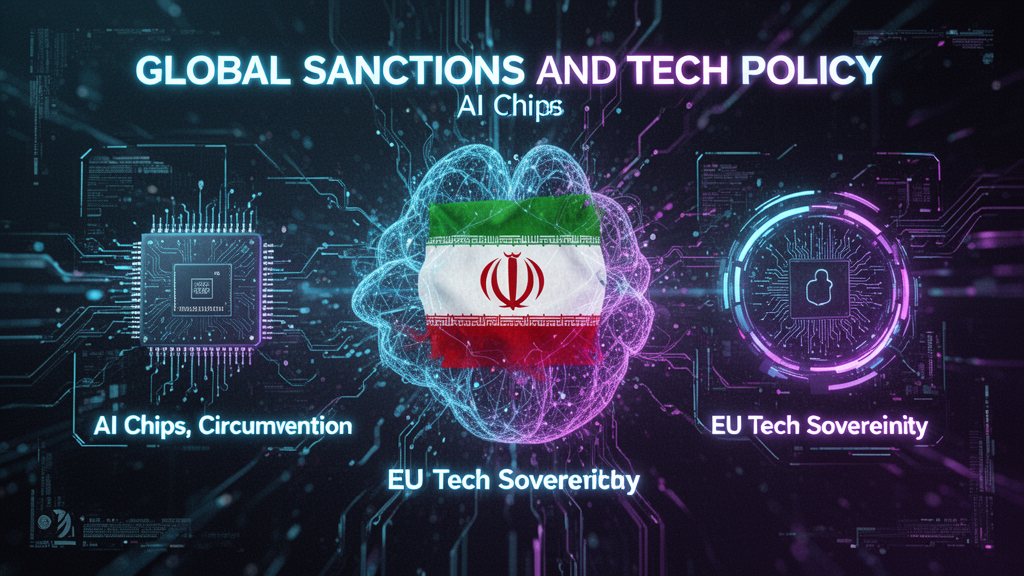
Global Sanctions and Tech Policy April 2026: AI Chips, Iran Circumvention, EU Tech Sovereignty
Table of Contents
Technology has moved to the center of global sanctions policy in April 2026. US chip export restrictions on China continue to shape AI development globally, Iran’s sanctions circumvention through Russian and Chinese partnerships is accelerating, the EU is advancing tech sovereignty initiatives in response to US-China technology competition, and the Pentagon intercepted what Trump called a “Chinese gift to Iran.” Here is the global sanctions and tech policy briefing for late April 2026.
US Chip Export Restrictions: The Ongoing China AI Battle
The US chip export restrictions on advanced semiconductors to China remain the most consequential technology policy action of the decade. In April 2026, the restrictions have been in place for over three years — long enough to assess their actual impact. Chinese AI labs like DeepSeek have developed techniques (sparse mixture-of-experts architectures, aggressive quantization, novel training data curation) that partially compensate for restricted access to advanced NVIDIA GPUs. DeepSeek’s V4 performance on coding benchmarks this week demonstrates that export restrictions have slowed but not stopped China’s AI capability development.
The US export control regime faces a structural dilemma: restrictions tight enough to significantly constrain Chinese AI development also impose costs on US semiconductor companies (Nvidia, AMD, Intel) that depend on China for a significant share of revenue. The Commerce Department’s April 2026 review is evaluating whether to expand or tighten restrictions — with competing pressures from national security agencies (tighten) and the semiconductor industry (ease).
Iran Sanctions Circumvention: The China-Russia Route
Russia and Iran are building a north-south trade corridor specifically designed to bypass Western sanctions, with Chinese logistical and financial support. The corridor routes Iranian oil exports through Russia and Central Asia to Chinese buyers, bypassing the Strait of Hormuz and Western payment clearing systems simultaneously. The April 21 US military interception of a sanctioned tanker in the Indo-Pacific — carrying what Trump described as a Chinese shipment to Iran — demonstrates that the circumvention network is operational and actively monitored by US intelligence.
Chinese firms marketing battlefield intelligence on US forces to regional actors (Washington Post, April 4) represents a new category of sanctions circumvention: not material goods but information products sold to actors the US has designated as adversaries. OFAC’s existing sanctions framework was not designed for AI-generated intelligence products as sanctionable exports — a regulatory gap that Congress and the executive branch are working to close.
EU Tech Sovereignty: The Policy Response to US-China Competition
The EU is advancing tech sovereignty initiatives in response to the AI arms race between the US and China. The European AI Act (August 2026 enforcement) establishes the EU as a regulatory standard-setter for global AI governance. Mistral’s April 2026 release of Medium 3 with built-in EU AI Act compliance features demonstrates that European AI companies are using the regulatory framework as a market differentiator — EU compliance as a feature, not a burden.
EU investment in homegrown compute infrastructure accelerated in Q1 2026, with new high-performance computing facilities announced in France, Germany, and Finland. The strategic logic: dependence on US hyperscalers for AI infrastructure creates geopolitical vulnerability in a world where cloud providers are signing classified military agreements with their home governments.
UK Post-Brexit Tech Policy: A Third Path
The UK is pursuing a distinct tech policy approach: lighter AI regulation than the EU (no AI Act equivalent), closer defense AI cooperation with the US (five-eyes intelligence sharing extended to AI systems), and an open approach to AI talent from both allied and non-allied nations. The UK’s strategy reflects a calculated bet that regulatory lightness will attract AI companies and talent, while the absence of an AI Act reduces compliance costs for UK-based companies relative to EU competitors.
 Illustrative photo · Photo by Jeremy Waterhouse on Pexels.
 Illustrative photo · Photo by Thomas Parker on Pexels.
 Illustrative photo · Photo by Kampus Production on Pexels.
 Illustrative photo · Photo by Héctor Berganza on Pexels.
Global Sanctions Tech Policy April 2026: Comprehensive Overview
The global sanctions tech policy April 2026 landscape represents an unprecedented convergence of trade restrictions, technology controls, and diplomatic pressure. As nations increasingly weaponize technology access, sanctions have evolved from financial penalties to comprehensive strategic instruments.
Our analysis of global sanctions tech policy April 2026 examines the key developments, their motivations, and their far-reaching consequences for global technology markets, supply chains, and geopolitical alignments.
US Chip Restrictions: Global Sanctions Tech Policy April 2026
Expanded Export Controls
The United States significantly expanded semiconductor export controls, forming the centerpiece of global sanctions tech policy April 2026. New restrictions targeted advanced AI chips, semiconductor manufacturing equipment, and design software.
The global sanctions tech policy April 2026 chip restrictions go beyond direct sales, encompassing products made with American technology regardless of manufacturing location. This extraterritorial reach forces global companies to comply or lose access to US markets and technology.
Cloud computing restrictions added a new dimension. The global sanctions tech policy April 2026 framework now limits access to advanced AI computing capabilities through cloud services, closing loopholes that allowed sanctioned entities to access compute power remotely.
Industry Impact
Major chipmakers including NVIDIA, AMD, and Intel reported significant revenue impacts from global sanctions tech policy April 2026 restrictions. Stock prices declined as investors priced in lost market access to major economies.
The restrictions accelerated Chinese domestic semiconductor development. Global sanctions tech policy April 2026 analysis shows Chinese firms increasing investment in indigenous chip manufacturing, though technological gaps remain significant in cutting-edge processes.
Global supply chains restructured in response. The global sanctions tech policy April 2026 environment created a bifurcated market, with some products available only in compliant jurisdictions, increasing costs and reducing innovation through market fragmentation.
Iran Sanctions Circumvention: Global Sanctions Tech Policy April 2026
Technology Sanctions on Iran
Iran remains a primary target within global sanctions tech policy April 2026 frameworks. Technology restrictions aim to limit Iran’s access to advanced computing, telecommunications equipment, and dual-use technologies supporting military and surveillance capabilities.
The global sanctions tech policy April 2026 Iran measures include restrictions on technology transfers, software exports, and technical assistance. Secondary sanctions target companies doing sanctioned business with Iran, creating global compliance pressure.
Enforcement intensified through Treasury and Commerce Department actions. Global sanctions tech policy April 2026 enforcement included designations of technology procurement networks attempting to supply sanctioned components to Iranian entities.
Circumvention Networks
Despite sanctions, circumvention networks adapted. The global sanctions tech policy April 2026 analysis documents sophisticated procurement operations using shell companies, transshipment through third countries, and cryptocurrency payments to obscure technology transfers.
Front companies in Southeast Asia, the Middle East, and Latin America facilitated technology diversion. The global sanctions tech policy April 2026 circumvention challenge requires constant intelligence updates as networks adapt to enforcement actions.
Cryptocurrency emerged as a key tool for sanctions evasion. The global sanctions tech policy April 2026 landscape includes increased focus on blockchain analytics to trace sanctioned-entity crypto transactions and disrupt funding channels.
EU Tech Sovereignty: Global Sanctions Tech Policy April 2026
Strategic Autonomy Push
The European Union’s pursuit of technology sovereignty represents a distinctive dimension of global sanctions tech policy April 2026. Rather than following US restrictions entirely, the EU developed independent assessment frameworks for technology risks.
The European Chips Act and AI Act work alongside global sanctions tech policy April 2026 measures to build domestic capabilities. The EU aims to reduce dependence on both American and Asian technology suppliers through strategic investments and regulatory frameworks.
Divergences between US and EU approaches created friction. Global sanctions tech policy April 2026 analysis shows European companies sometimes caught between US sanctions and EU strategic autonomy objectives, creating compliance complexity.
Regulatory Instruments
The EU deployed new regulatory tools within the global sanctions tech policy April 2026 framework. The Anti-Coercion Instrument, Foreign Subsidies Regulation, and updated trade defense mechanisms provide additional policy levers.
These tools reflect Europe’s global sanctions tech policy April 2026 philosophy: rather than matching US and Chinese industrial subsidy scale, the EU uses regulatory power to shape market behavior and protect strategic interests.
China’s Response: Global Sanctions Tech Policy April 2026
Counter-Sanctions and Retaliation
China responded to global sanctions tech policy April 2026 restrictions with counter-measures including export controls on critical minerals essential for semiconductor and defense manufacturing. Gallium, germanium, and graphite restrictions disrupted global supply chains.
China’s Unreliable Entity List and counter-sanctions laws added tools to the global sanctions tech policy April 2026 arsenal. Chinese regulators increased scrutiny of foreign technology companies operating domestically.
The global sanctions tech policy April 2026 tit-for-tat dynamic risks escalation spirals where each side’s restrictions provoke broader retaliation, fragmenting global technology markets and increasing costs for all participants.
Indigenous Technology Development
China accelerated self-sufficiency programs in response to global sanctions tech policy April 2026 pressure. Massive investments in semiconductor manufacturing, AI development, and critical technologies aim to reduce foreign dependence.
Progress varies by sector. The global sanctions tech policy April 2026 assessment shows China advancing rapidly in mature chip nodes and some AI applications while still lagging in cutting-edge manufacturing and advanced design tools.
Technology Decoupling: Global Sanctions Tech Policy April 2026
Supply Chain Restructuring
The global sanctions tech policy April 2026 environment drives significant supply chain restructuring. Companies diversify suppliers, relocate manufacturing, and redesign products to navigate competing regulatory regimes.
Friend-shoring, near-shoring, and reshoring strategies accelerated. Global sanctions tech policy April 2026 analysis shows Vietnam, India, and Mexico benefiting as alternative manufacturing locations, though capacity building takes years.
Innovation Impacts
Technology decoupling threatens collaborative innovation models that drove decades of progress. The global sanctions tech policy April 2026 fragmentation reduces cross-border research collaboration, talent mobility, and shared standards development.
Duplicate innovation efforts waste resources. The global sanctions tech policy April 2026 environment forces companies to develop separate products for different markets, increasing costs and slowing advancement across the technology sector.
Compliance Challenges: Global Sanctions Tech Policy April 2026
Corporate Compliance Burden
Companies face enormous global sanctions tech policy April 2026 compliance challenges. Overlapping and sometimes conflicting sanctions regimes require sophisticated compliance programs with continuous monitoring and rapid adaptation capabilities.
Technology companies particularly struggle with global sanctions tech policy April 2026 requirements around dual-use classification, end-user verification, and technology transfer controls. Compliance costs have increased dramatically across the industry.
Financial Institution Requirements
Banks and payment processors bear significant global sanctions tech policy April 2026 compliance loads. Transaction screening, correspondent banking due diligence, and sanctions-specific risk assessments require substantial technology and personnel investments.
Future Direction of Global Sanctions Tech Policy April 2026
The global sanctions tech policy April 2026 trajectory suggests continued escalation and complexity. Technology sanctions are becoming permanent features of international relations rather than temporary measures.
For businesses, global sanctions tech policy April 2026 demands strategic rather than purely compliance-focused responses. Organizations must design products, supply chains, and business models resilient to an environment where technology access is increasingly constrained by geopolitical considerations.
The long-term consequences of global sanctions tech policy April 2026 extend beyond economics to fundamental questions about global cooperation, innovation models, and the future of interconnected technology ecosystems. How nations navigate these tensions will shape the global order for decades to come.
Frequently Asked Questions About global sanctions tech policy April 2026
What is global sanctions tech policy April 2026 and why is it important?
Understanding global sanctions tech policy April 2026 is critical for professionals and organizations navigating today’s rapidly evolving landscape. This topic directly impacts strategic decisions, operational efficiency, regulatory compliance, and long-term competitiveness in the marketplace.
How can organizations prepare for global sanctions tech policy April 2026?
Organizations should conduct thorough assessments of their current capabilities, invest in team training and development, develop implementation roadmaps with clear milestones, and establish monitoring systems to track progress. Staying informed about global sanctions tech policy April 2026 developments ensures proactive rather than reactive responses.
What are the main challenges associated with global sanctions tech policy April 2026?
The primary challenges include resource constraints, skill gaps, regulatory compliance requirements, technology integration complexities, and the need for continuous adaptation. However, these challenges also present opportunities for innovation, differentiation, and competitive advantage.
How does global sanctions tech policy April 2026 compare to previous approaches?
Compared to earlier methods and frameworks, global sanctions tech policy April 2026 represents a significant evolution in both scope and impact. The pace of change has accelerated dramatically, requiring more agile, informed, and proactive approaches from all stakeholders involved.
What should readers watch for regarding global sanctions tech policy April 2026?
Key indicators to monitor include regulatory developments, market adoption rates, technological breakthroughs, expert analyses, and industry best practices. Subscribing to reputable newsletters and following thought leaders provides valuable ongoing insights.
Expert Insights and Strategic Analysis
Industry experts and analysts have been closely monitoring developments related to global sanctions tech policy April 2026, offering valuable perspectives on current trends and future directions that provide additional context and depth.
Professional Perspectives
Leading professionals emphasize that global sanctions tech policy April 2026 represents a fundamental shift rather than an incremental change. The implications extend across organizational boundaries, affecting strategy, operations, technology infrastructure, and organizational culture simultaneously.
Common Pitfalls to Avoid
Several common mistakes can undermine effectiveness when addressing global sanctions tech policy April 2026. These include underestimating implementation complexity, failing to secure adequate resources, neglecting change management, treating initiatives as one-time projects rather than ongoing programs, and insufficient stakeholder communication.
Building a Sustainable Approach
Sustainability in the context of global sanctions tech policy April 2026 requires ongoing commitment, regular reassessment, and adaptive planning. Organizations should establish feedback loops, monitor key performance indicators, and adjust strategies as conditions evolve over time.
The Competitive Advantage of Early Adoption
Organizations that move quickly to understand and address global sanctions tech policy April 2026 often gain significant competitive advantages including enhanced reputation, improved operational efficiency, stronger regulatory positioning, and the ability to shape industry standards and best practices.
Recommendations for Different Organization Sizes
The approach to global sanctions tech policy April 2026 should vary based on organizational size. Large enterprises can invest in dedicated teams and comprehensive programs. Mid-sized organizations benefit from focused initiatives. Small organizations should prioritize foundational steps and leverage external expertise.
Conclusion and Future Outlook
This comprehensive analysis of global sanctions tech policy April 2026 has explored multiple dimensions including current trends, strategic considerations, best practices, risk management, and future outlook. The key takeaway is that global sanctions tech policy April 2026 demands proactive engagement from organizations of all sizes. By implementing the strategies and recommendations discussed, readers can position themselves effectively. Continuous learning, strategic planning, and adaptive execution remain the cornerstones of success.
Deep Dive: Understanding global sanctions tech policy April 2026 in Practice
Real-World Applications and Case Studies
Examining real-world applications of global sanctions tech policy April 2026 reveals practical insights that theoretical frameworks alone cannot provide. Organizations across various sectors have implemented strategies addressing global sanctions tech policy April 2026 with varying degrees of success. Their experiences offer valuable lessons for others embarking on similar journeys. Case studies demonstrate that success depends on factors including leadership commitment, resource allocation, stakeholder engagement, and adaptation to local conditions.
Implementation Framework for global sanctions tech policy April 2026
A structured implementation framework for global sanctions tech policy April 2026 typically includes several phases. The assessment phase evaluates current state and identifies gaps. The planning phase develops detailed roadmaps with timelines and resource requirements. The execution phase implements planned activities while monitoring progress. The optimization phase refines approaches based on outcomes and feedback. Each phase requires specific competencies and deliverables.
Measuring ROI and Impact
Demonstrating return on investment for global sanctions tech policy April 2026 initiatives requires clear metrics and consistent measurement. Quantitative measures might include cost savings, revenue improvements, efficiency gains, and risk reduction. Qualitative indicators encompass stakeholder satisfaction, brand reputation, competitive positioning, and strategic alignment. Organizations should establish baseline measurements before implementation to enable meaningful before-and-after comparisons.
Integration with Existing Systems
Integrating global sanctions tech policy April 2026 considerations into existing organizational systems and processes requires careful planning. This includes aligning with current technology infrastructure, incorporating into governance frameworks, embedding into operational procedures, and reflecting in performance metrics. Successful integration minimizes disruption while maximizing value, creating synergies rather than conflicts with established practices.
Training and Capability Building
Building internal capabilities for managing global sanctions tech policy April 2026 requires comprehensive training programs. These should address both technical skills and broader competencies including strategic thinking, risk assessment, and change management. Effective programs combine formal training, hands-on experience, mentorship, and continuous learning opportunities. Investment in human capital yields the highest returns for sustainable success.
Regulatory and Compliance Considerations
The regulatory landscape surrounding global sanctions tech policy April 2026 continues to evolve, with new requirements emerging regularly. Organizations must maintain awareness of applicable regulations, implement compliance measures, document their efforts, and prepare for potential audits or assessments. Engaging with regulatory bodies and industry associations provides early visibility into upcoming changes and opportunities to shape policy development.
Final Thoughts on global sanctions tech policy April 2026
As this analysis demonstrates, global sanctions tech policy April 2026 is a multifaceted topic that demands comprehensive understanding and strategic response. The organizations and individuals who invest in building knowledge, developing capabilities, and maintaining vigilance will be best positioned to thrive amid ongoing changes. The journey requires commitment, resources, and adaptability, but the potential rewards justify the investment. We encourage readers to continue exploring this topic, engaging with expert communities, and implementing the strategies discussed to achieve their objectives.