Table of Contents
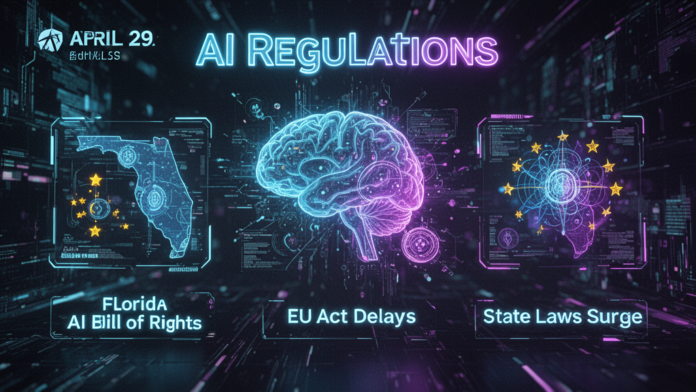
AI regulation activity accelerated sharply in the final week of April 2026. Florida’s Senate passed an AI Bill of Rights, Connecticut passed comprehensive AI legislation, California advanced multiple AI bills through committee, and EU institutions signaled potential delays to key compliance deadlines. Here is the complete regulatory picture as of April 29, 2026.
Florida Senate Passes AI Bill of Rights
Florida’s Senate passed an AI Bill of Rights on April 28, 2026, during a four-day special session. The bill covers consumer rights in AI interactions, requirements for AI system transparency, and restrictions on automated decision-making in employment and housing contexts. The legislation is identical to a bill the Senate passed in March, though it had not previously been taken up by the House. With both chambers now aligned, Florida becomes one of the most significant U.S. states to advance comprehensive AI consumer protection legislation.
Connecticut AI Act Passes Senate
Connecticut Senator James Maroney’s AI bill passed the Senate this week, covering companion chatbots, AI in employment decisions, content provenance, and the regulation of frontier model developers. Connecticut’s bill is notable for its explicit focus on frontier model developers — not just AI applications — placing obligations on companies like OpenAI, Anthropic, and Google at the model development level. This is a relatively new regulatory approach that, if adopted broadly, would significantly increase compliance burdens for AI labs.
California Advances Multiple AI Bills Through Committee
California lawmakers passed numerous AI bills out of committees this week, including four chatbot regulation bills, three healthcare AI bills, two employment AI bills, and a content provenance bill. California’s AB 2713 (California AI Transparency Act: system provenance data) was voted out of the Assembly Privacy and Consumer Protection Committee and is now on a third floor reading. California’s legislative pace on AI is accelerating, with over 30 AI-related bills in active committee consideration as of late April 2026.
EU AI Act: Compliance Deadlines May Shift to 2027–2028
In a significant development for multinational enterprises, EU institutions are actively considering pushing key AI Act compliance deadlines from August 2026 to 2027–2028, reflecting implementation challenges and concerns about regulatory burden on European businesses. The general-purpose AI model provisions, which affect frontier model providers, are the most contested. However, enterprises should not treat potential delays as an invitation to pause compliance work — the direction of travel is clear, and early compliance programs provide competitive differentiation in regulated sectors.
White House National AI Policy Framework: What It Means
The White House’s National Policy Framework for Artificial Intelligence, published in April 2026, emphasizes voluntary commitments by AI developers, sector-specific federal agency guidance, and deference to state-level legislation where federal frameworks are absent. The framework explicitly rejects a comprehensive federal AI Act on the EU model, instead relying on existing regulatory agencies (FTC, FDA, SEC, CFPB) to enforce AI-related requirements within their existing jurisdictions. For enterprises, this means navigating a patchwork of state laws rather than a single federal standard — at least through 2026.
What Enterprises Must Do Before August 2026
Three immediate priorities for enterprises operating AI systems in regulated sectors: First, map all AI use cases against EU AI Act risk classifications before the August 2026 enforcement date — even if deadline extensions are granted, compliance documentation takes months. Second, review employment AI practices against Connecticut and Florida’s new requirements, which apply to systems operating in those states regardless of company headquarters. Third, implement provenance and transparency mechanisms for AI-generated content, as California’s AB 2713 and similar bills in 12 other states are moving toward enactment.
The Landscape of AI Regulations April 2026 State Laws
The rapid emergence of AI regulations April 2026 state laws marks a turning point in how American jurisdictions govern artificial intelligence. With federal legislation stalled, states are filling the void with a patchwork of rules that create both opportunities and compliance headaches for businesses operating nationwide.
April 2026 alone saw multiple states advance or enact AI-related legislation. From Florida’s AI Bill of Rights to Connecticut’s comprehensive AI law and California’s transparency bills, the regulatory landscape is fragmenting. Companies must now track and comply with dozens of distinct state-level requirements.
Why States Are Leading on AI Regulation
The push behind AI regulations April 2026 state laws stems from congressional inaction. Federal AI legislation has been stuck in partisan gridlock, with disagreements over preemption, liability, and enforcement mechanisms. States, frustrated by the lack of federal action, are moving independently to protect their residents.
State attorneys general and legislatures see AI regulation as both a consumer protection issue and a competitive differentiator. Some states want to attract AI companies with lighter touch rules, while others prioritize resident protection. This creates a tension that shapes every piece of AI regulations April 2026 state laws.
Florida AI Bill of Rights: Scope and Implications
Florida’s AI Bill of Rights is among the most significant of the AI regulations April 2026 state laws. The legislation establishes a framework for how AI systems can be used in employment, housing, healthcare, and criminal justice. It requires transparency when AI is used in consequential decisions and gives residents the right to human review.
The Florida bill also prohibits certain high-risk uses of AI outright, including real-time facial recognition in public spaces without a warrant and AI-driven predictive policing without audit trails. These prohibitions set Florida apart from states that take a purely disclosure-based approach.
Compliance Requirements for Florida Businesses
Under Florida’s AI regulations April 2026 state laws, businesses using AI for hiring must disclose AI use to applicants, provide an opt-out mechanism, and maintain records of AI-assisted decisions for at least two years. Healthcare providers using AI for diagnosis or treatment recommendations must inform patients and obtain consent.
The compliance burden is significant but manageable for well-prepared organizations. The key is documentation: every AI system needs a clear use case, a documented risk assessment, and a human oversight protocol. Companies that implement these practices can comply with Florida’s requirements without major operational disruption.
Connecticut AI Law: A Comprehensive Approach
Connecticut’s AI law, another pillar of AI regulations April 2026 state laws, takes a broader approach. It classifies AI systems by risk level—minimal, limited, high, and unacceptable—and imposes requirements proportional to each tier. High-risk systems, such as those used in credit scoring or employment screening, face the strictest obligations.
The Connecticut law borrows structural elements from the EU AI Act, including risk-tiering and mandatory impact assessments. However, it adapts these concepts to the American legal context, emphasizing state enforcement rather than a dedicated regulatory body. The attorney general has primary enforcement authority.
How Connecticut’s Risk Tiers Work in Practice
For businesses navigating AI regulations April 2026 state laws, Connecticut’s risk tiers provide a useful compliance framework. Minimal-risk systems, like spam filters, face no specific requirements. Limited-risk systems must provide transparency notices. High-risk systems require impact assessments, bias testing, and ongoing monitoring.
Unacceptable-risk systems—those that manipulate behavior subliminally or score citizens socially—are prohibited. This tiered approach lets companies prioritize compliance efforts where risk is highest, rather than treating every AI deployment with the same intensity.
California Transparency Bills: Shedding Light on AI Use
California’s contributions to AI regulations April 2026 state laws focus on transparency. Multiple bills require companies to disclose when AI generates content, when AI is used in customer interactions, and when AI influences decisions about consumers. California’s approach is less restrictive than Florida’s or Connecticut’s but more expansive in coverage.
The transparency bills apply to a wide range of industries, from entertainment to e-commerce. A key provision requires AI-generated media—including deepfakes and synthetic voices—to carry clear disclosures. This addresses growing concerns about misinformation and fraud facilitated by generative AI.
Impact on Content Creators and Platforms
California’s transparency rules within AI regulations April 2026 state laws have significant implications for social media platforms and content creators. Platforms must label AI-generated content and provide tools for users to report undisclosed synthetic media. Content creators using AI tools must disclose this in their posts.
For platforms, the technical challenge is detecting AI-generated content at scale. Current detection tools have high false-positive and false-negative rates. California’s rules effectively push platforms to invest in better detection technology, creating a new market for AI content authentication tools.
EU AI Act Delays: Transatlantic Implications
While AI regulations April 2026 state laws dominate the domestic landscape, the EU AI Act’s implementation delays are creating transatlantic compliance complexity. The EU pushed back key compliance deadlines, giving companies more time but also extending the period of regulatory uncertainty.
For US companies operating in Europe, the delays are a mixed blessing. More preparation time is welcome, but the lack of final guidance on key provisions—such as what constitutes a high-risk system—makes it difficult to plan compliance investments. Many companies are building to the expected rules rather than waiting for final text.
How EU Delays Affect US State Law Development
Interestingly, the EU AI Act delays are influencing AI regulations April 2026 state laws. Some state legislators, seeing the EU struggle with implementation, are pushing for more pragmatic, enforcement-ready rules. Others are doubling down on EU-style frameworks, arguing that comprehensive rules are better even if implementation is delayed.
This divergence means companies may face EU-inspired rules in Connecticut, disclosure-focused rules in California, and prohibition-based rules in Florida—all simultaneously. Compliance teams must build flexible frameworks that can adapt to multiple regulatory philosophies.
The Compliance Challenge for Multi-State Businesses
The fragmentation of AI regulations April 2026 state laws creates a major challenge for businesses operating across state lines. A company using AI for hiring may need to follow Florida’s disclosure and opt-out rules for Florida applicants, Connecticut’s impact assessment requirements for Connecticut applicants, and California’s transparency rules for California applicants.
The practical solution is to build compliance to the highest standard and apply it universally. This is more expensive than state-by-state compliance but reduces operational complexity and legal risk. Many large enterprises are adopting this approach, effectively treating the strictest state law as their national baseline.
Building a Multi-State AI Compliance Program
A robust compliance program for AI regulations April 2026 state laws should include: an AI system inventory, risk classification of each system, state-by-state requirement mapping, documented impact assessments, bias testing protocols, transparency disclosure templates, and a regular compliance review cycle.
Smaller companies can leverage compliance-as-a-service platforms that track state AI laws and provide automated requirement mapping. These tools are becoming essential as the number of AI regulations April 2026 state laws grows beyond what manual tracking can handle.
Looking Forward: What Comes After April 2026
The AI regulations April 2026 state laws wave is likely to accelerate. At least a dozen additional states have AI legislation in draft or committee stages. By the end of 2026, a majority of states could have some form of AI regulation on the books.
Businesses should expect convergence over time—states will learn from each other and align on best practices. But the next 12–18 months will be characterized by divergence and experimentation. Companies that build flexible, well-documented compliance programs now will navigate this period more smoothly than those waiting for regulatory clarity.
Three Immediate Steps for Compliance Teams
First, map your AI systems to the states where they affect residents. Second, conduct gap assessments against current AI regulations April 2026 state laws in Florida, Connecticut, and California. Third, establish a regulatory monitoring process to track new state legislation monthly. Proactive compliance is cheaper than reactive enforcement defense.
Enforcement Mechanisms: Who Polices the Rules?
A crucial question for AI regulations April 2026 state laws is enforcement. Laws without enforcement are guidelines, not regulations. Florida’s bill grants enforcement authority to the state attorney general and allows private rights of action in certain cases. Connecticut’s law similarly empowers its attorney general but does not include private litigation rights.
California relies on a combination of attorney general enforcement and agency-specific oversight. This fragmented enforcement means the same AI system could face different enforcement risks depending on the state. Companies should map enforcement authority by state as part of their compliance planning.
Penalties and Their Deterrent Effect
The penalty structures in AI regulations April 2026 state laws vary significantly. Florida’s bill includes civil penalties of up to $50,000 per violation, with a cap on total penalties per investigation. Connecticut’s law allows penalties proportional to the company’s revenue, creating larger financial risk for big tech companies.
California’s transparency bills include both civil penalties and mandatory corrective action. The threat of penalties alone is not always sufficient—enforcement requires resources and political will. States with well-funded attorney general offices are more likely to enforce their AI laws aggressively than those with limited resources.
The Preemption Question: Can Federal Law Override States?
A long-debated question in AI regulations April 2026 state laws is whether federal legislation could preempt state rules. Industry groups have lobbied for federal preemption, arguing that a patchwork of state laws creates excessive compliance costs. Consumer advocates counter that state experimentation drives better regulation.
Any federal AI bill that includes preemption would likely set a floor, not a ceiling—states could enforce stricter rules but not weaker ones. This would preserve state innovation while reducing compliance complexity for minimal-risk AI uses. However, the political path to such a compromise remains unclear.
International Comparisons: How US States Compare Globally
The AI regulations April 2026 state laws are part of a global regulatory landscape that includes the EU AI Act, China’s AI governance rules, and emerging frameworks in Brazil, Japan, and the UK. Comparing US state laws to international approaches provides perspective on their stringency and scope.
Florida’s AI Bill of Rights is more restrictive than the EU AI Act in some areas—particularly facial recognition prohibitions—but less comprehensive in coverage. Connecticut’s risk-tiered approach closely mirrors the EU framework. California’s transparency focus aligns with UK regulatory philosophy. The diversity of AI regulations April 2026 state laws means US companies effectively face a laboratory of regulatory models.
What Multinational Companies Should Do
For multinationals, AI regulations April 2026 state laws add another layer to an already complex compliance picture. A global company must comply with EU requirements, Chinese data rules, and now varying US state laws. The practical approach is to build to the most stringent standard—typically the EU AI Act—and apply it universally.
This approach reduces complexity but may over-comply in less restrictive jurisdictions, creating competitive disadvantages against local competitors who face lighter rules. The AI regulations April 2026 state laws environment requires strategic choices about where to standardize and where to customize compliance approaches by jurisdiction.
Frequently Asked Questions About AI regulations April 2026 state laws
What is AI regulations April 2026 state laws and why does it matter?
Understanding AI regulations April 2026 state laws is essential for professionals and businesses navigating today’s rapidly evolving landscape. This topic directly impacts strategic decisions, operational efficiency, and long-term competitiveness.
How can organizations prepare for changes related to AI regulations April 2026 state laws?
Organizations should conduct thorough assessments, invest in training, and develop implementation roadmaps. Staying informed about AI regulations April 2026 state laws developments ensures proactive rather than reactive responses.
What are the key challenges associated with AI regulations April 2026 state laws?
The primary challenges include resource constraints, skill gaps, regulatory compliance, and the need for continuous adaptation. However, these challenges also present opportunities for innovation and differentiation.

