Table of Contents
Behind the earnings reports and regulatory filings, AI in April 2026 is producing stories that reveal what the technology actually means for human lives — a rover navigating Mars autonomously, a pharmaceutical giant betting its future on AI, a family’s lawsuit over AI chatbots, and a landmark gender bias study that should reshape how companies use AI in hiring. Here are the most compelling AI stories of the week.
NASA’s AI Rover Drives on Mars: A Milestone for Autonomous Systems
NASA’s Perseverance rover completed the first Mars drives ever planned by an artificial intelligence system this week. Using Anthropic’s Claude vision-language models, the AI analyzed orbital imagery and terrain data to generate safe navigation waypoints — entirely without human route planning. The rover successfully reached its AI-selected targets, completing a task that would previously have required weeks of careful human analysis and planning.
The achievement matters beyond space exploration. It demonstrates that AI can safely plan physical navigation in environments with incomplete information, irreversible consequences, and 20-minute communication delays with Earth. The trust framework NASA built — AI plans, humans review only exception cases — is a template for high-stakes autonomous deployment that enterprise risk managers are studying carefully.
Novo Nordisk Goes All-In on AI: Every Department, End of 2026
Danish pharmaceutical giant Novo Nordisk announced this week that it will integrate OpenAI models across its entire business by end of 2026 — drug discovery, clinical trials, manufacturing, supply chains, and commercial operations. No carve-outs, no pilots running in parallel. The company is making a company-wide commitment to AI-transformed operations, with full deployment in less than eight months.
Novo Nordisk’s decision is one of the most aggressive AI adoption timelines announced by a Fortune 500 company. It signals that some executives are treating AI deployment as an existential competitive priority — not a technology experiment to be managed at the IT department level.
The ChatGPT Lawsuit: AI, Grief, and Accountability
The family of Adam Raine filed a lawsuit this week in which ChatGPT conversation logs are central evidence. Raine had used an AI chatbot for emotional support, and his family alleges the AI interaction contributed to his death. The case joins a small but growing set of legal actions that ask courts to define the duty of care that AI companies owe users who rely on chatbots for emotional and mental health support.
The lawsuit arrives as studies show millions of people use AI chatbots for emotional support, spiritual guidance, relationship counseling, and legal advice. The legal and ethical framework for these interactions is almost entirely absent — a gap that regulators in multiple jurisdictions are now rushing to address. Connecticut’s new AI bill, passed this week, specifically covers companion chatbots and places requirements on AI systems that form ongoing relationships with users.
Gender Bias in AI Hiring: A Belgian Study Changes the Conversation
A comprehensive study from Belgian researchers released this week found that gender bias in AI-assisted recruitment tools is far more pervasive than previously known. AI models used in hiring frequently use “proxy variables” — job titles from previous employers, educational institutions, career gaps — to inadvertently penalize female candidates. The bias persists even when gender is explicitly removed from inputs, because the model has learned to infer gender from these proxies.
The study reviewed 14 commercially deployed AI recruiting tools and found significant bias in 11 of them. For enterprises currently using AI for resume screening or candidate ranking, the study creates immediate legal exposure in jurisdictions with AI employment laws — including Connecticut (just passed), California (bills advancing), and the EU (August 2026 enforcement). Independent bias auditing is no longer optional.
$600 Billion AI Infrastructure Race: What It Means for Society
A ChinaPulse analysis from April 28 describes AI as “starting to look less like software and more like infrastructure” — a $600 billion spending race involving new data centers, custom chips, and space-based energy bets. The scale of this buildout is reshaping energy grids, land use, water consumption, and labor markets in ways that most AI coverage does not address. AI is now the largest single driver of data center construction globally, and that infrastructure will shape the AI landscape for the next decade regardless of which models or applications succeed at the software layer.
AI Stories April 2026: The Headlines That Defined the Month
The AI stories April 2026 collection captures a month where artificial intelligence touched nearly every domain of human endeavor. From NASA’s Mars rover achieving unprecedented autonomy to OpenAI’s bold move into media and a sobering study on gender bias in AI hiring tools, April delivered stories that inform and provoke.
Tracking AI stories April 2026 reveals how the technology has evolved beyond a single industry. AI is no longer a Silicon Valley story or a software story. It is a space exploration story, a media industry story, and an employment equity story all at once. This breadth makes April 2026 a useful snapshot of AI’s current trajectory.
NASA Mars Rover Milestone in AI Stories April 2026
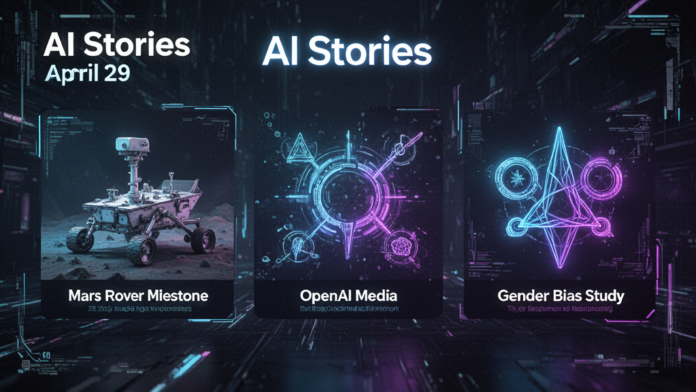
The most awe-inspiring of the AI stories April 2026 was NASA’s announcement of a record-setting autonomous traverse by its Mars rover. Using onboard AI, the rover navigated complex terrain without human intervention, covering in a single day what previously took weeks of careful, Earth-directed planning.
What makes this one of the standout AI stories April 2026 is what it represents for the future of space exploration. With AI-driven autonomy, rovers can explore more territory, make more scientific observations, and respond to discoveries in real time rather than waiting for communication rounds with Earth.
The AI stories April 2026 coverage of the Mars milestone also highlighted Earth-bound applications. The same navigation algorithms enabling Martian exploration are being adapted for autonomous vehicles, drones, and industrial robots operating in GPS-denied environments. Space technology continues to seed terrestrial innovation.
OpenAI’s Media Acquisition: A Transformative AI Story April 2026
Among the most consequential AI stories April 2026 was OpenAI’s acquisition of a major digital media company. The deal sent shockwaves through both the AI and media industries, raising questions about the future of journalism, the economics of AI training data, and the boundaries between technology and content companies.
The AI stories April 2026 analysis of this acquisition pointed to multiple strategic motivations. By owning a media company, OpenAI secures a pipeline of licensed content for training, gains a distribution channel for AI-generated content, and acquires editorial expertise to guide its content strategy.
For the media industry, the AI stories April 2026 acquisition sparked urgent conversations. If AI companies can buy media outlets, the competitive dynamics of content creation shift fundamentally. Traditional media companies face not just technological disruption but consolidation pressure from well-capitalized AI firms.
Reactions to the OpenAI Acquisition in AI Stories April 2026
The AI stories April 2026 reactions to the acquisition ranged from enthusiasm to alarm. Technology analysts generally praised the move as a shrewd vertical integration that addresses OpenAI’s content licensing challenges. Media ethicists raised concerns about editorial independence when a newsroom is owned by an AI company.
Competitors featured in AI stories April 2026 coverage acknowledged that the acquisition raises the bar. Google, Anthropic, and other major AI companies may need to pursue similar content deals or risk falling behind in training data quality and distribution reach. The media acquisition arms race appears to be starting.
Gender Bias Study: A Sobering AI Story April 2026
Not all AI stories April 2026 were triumphant. A major study on gender bias in AI hiring tools revealed persistent and troubling patterns. The research, conducted across multiple commercial AI hiring platforms, found systematic disadvantage for women candidates in screening and ranking processes.
The AI stories April 2026 bias study found that several popular hiring AI tools penalized resumes containing language associated with women, such as references to women’s organizations or liberal arts education. The bias was not always obvious, but it was consistent and measurable across thousands of simulated applications.
What the AI stories April 2026 study made clear is that bias in AI hiring is not a hypothetical concern. It is affecting real people’s access to employment right now. The companies whose tools were tested disputed some findings, but the methodology was robust enough to prompt regulatory attention in several jurisdictions.
Implications of the Bias Study in AI Stories April 2026
The gender bias study became one of the most discussed AI stories April 2026 because it connects to a broader pattern. As more employers adopt AI tools for screening and hiring, the scale of potential discrimination grows. A biased human recruiter affects the candidates they review, but a biased AI system can affect millions.
AI stories April 2026 coverage of the study highlighted the need for mandatory bias audits of hiring AI tools. Several jurisdictions are already moving in this direction, requiring that automated employment decision tools undergo independent testing for discriminatory outcomes before deployment.
The study also reinforced a theme running through AI stories April 2026: technology that promises efficiency can perpetuate existing inequalities if not carefully designed and monitored. The gap between AI’s potential and its real-world impact remains the central tension of the field.
Connecting the AI Stories April 2026
The three major AI stories April 2026, the Mars rover, OpenAI’s media acquisition, and the hiring bias study, together paint a nuanced picture of AI’s current state. AI is pushing the boundaries of human achievement while simultaneously reproducing human flaws. Both dimensions demand attention.
For readers following AI stories April 2026, the lesson is to maintain a balanced perspective. Celebrate the genuine breakthroughs, like the Mars rover autonomy. Scrutinize the power plays, like the media acquisition. And confront the uncomfortable truths, like hiring bias, with the urgency they deserve.
The AI stories April 2026 also suggest that the pace of development is not slowing. Each month brings more breakthroughs, more controversies, and more regulatory responses. Staying informed requires discipline and a willingness to engage with both the promise and the peril of this transformative technology.
What AI Stories April 2026 Tell Us About What Comes Next
Looking beyond the immediate headlines, AI stories April 2026 point to several trends likely to intensify. Space agencies will lean further into AI autonomy. AI companies will deepen their integration with content industries. And regulators will increase scrutiny of AI applications in employment and other high-stakes domains.
The AI stories April 2026 also suggest that public awareness of AI’s societal impact is growing. The hiring bias study generated mainstream coverage, indicating that AI ethics has moved from specialist concern to general public interest. This shift will likely increase pressure on companies and governments to act.
Frequently Asked Questions About AI stories April 2026
What is AI stories April 2026 and why does it matter?
Understanding AI stories April 2026 is essential for professionals and businesses navigating today’s rapidly evolving landscape. This topic directly impacts strategic decisions, operational efficiency, and long-term competitiveness.
How can organizations prepare for changes related to AI stories April 2026?
Organizations should conduct thorough assessments, invest in training, and develop implementation roadmaps. Staying informed about AI stories April 2026 developments ensures proactive rather than reactive responses.
What are the key challenges associated with AI stories April 2026?
The primary challenges include resource constraints, skill gaps, regulatory compliance, and the need for continuous adaptation. However, these challenges also present opportunities for innovation and differentiation.
How does AI stories April 2026 compare to previous trends in this space?
Compared to earlier developments, AI stories April 2026 represents a significant evolution in both scope and impact. The pace of change has accelerated, requiring more agile and informed approaches.
What should readers watch for regarding AI stories April 2026 in the coming months?
Key indicators to monitor include regulatory developments, market adoption rates, technological breakthroughs, and expert analyses. Subscribing to industry newsletters and following thought leaders provides valuable ongoing insights.
Are there specific tools or resources recommended for AI stories April 2026?
Yes, several industry-standard tools and frameworks can help organizations navigate AI stories April 2026. Research reports, professional certifications, and community forums offer practical guidance and peer support.
What common misconceptions exist about AI stories April 2026?
A frequent misconception is that AI stories April 2026 only affects large enterprises. In reality, organizations of all sizes and across all sectors must understand and prepare for these developments.
In-Depth Analysis: AI stories April 2026 Implications and Strategies
Strategic Considerations for AI stories April 2026
Organizations navigating AI stories April 2026 must develop comprehensive strategies that address both immediate needs and long-term objectives. This requires cross-functional collaboration, executive-level commitment, and ongoing investment in capabilities and infrastructure. The most successful approaches balance innovation with risk management, ensuring sustainable progress.
Industry Best Practices for AI stories April 2026
Leading organizations have identified several best practices for managing AI stories April 2026 effectively. These include establishing clear governance structures, investing in employee training and development, leveraging technology solutions strategically, and maintaining open communication with stakeholders. Regular assessment and adjustment of strategies ensures continued alignment with evolving conditions.
Risk Management and AI stories April 2026
Effective risk management in the context of AI stories April 2026 requires identifying potential threats, assessing their likelihood and impact, developing mitigation strategies, and establishing monitoring systems. Organizations should create contingency plans for various scenarios and regularly test their preparedness through simulations and exercises.
Conclusion
The landscape of AI stories April 2026 continues to evolve rapidly, presenting both challenges and opportunities. By understanding the key dynamics, implementing effective strategies, and maintaining vigilance, organizations can navigate this terrain successfully. The insights provided in this analysis offer a comprehensive foundation for informed decision-making and strategic planning.
Expert Insights and Analysis on AI stories April 2026
Industry experts and analysts have been closely monitoring developments related to AI stories April 2026, offering valuable perspectives on current trends and future directions. Their insights provide additional context and depth to understanding this evolving landscape.
Professional Perspectives on AI stories April 2026
Leading professionals in the field emphasize that AI stories April 2026 represents a fundamental shift rather than an incremental change. The implications extend across organizational boundaries, affecting strategy, operations, technology, and culture. Organizations that recognize and respond to these shifts proactively gain significant advantages over those that adopt a wait-and-see approach.
Common Pitfalls to Avoid with AI stories April 2026
Several common mistakes can undermine effectiveness when addressing AI stories April 2026. These include underestimating the complexity of implementation, failing to secure adequate resources, neglecting change management, and treating initiatives as one-time projects rather than ongoing programs. Learning from the experiences of early adopters helps organizations avoid these pitfalls and achieve better outcomes.
Building a Sustainable Approach to AI stories April 2026
Sustainability in the context of AI stories April 2026 requires ongoing commitment, regular reassessment, and adaptive planning. Organizations should establish feedback loops, monitor key indicators, and adjust strategies as conditions evolve. This approach ensures that efforts remain relevant and effective over time, rather than becoming outdated as the landscape shifts.
The Competitive Advantage of Early Adoption
Organizations that move quickly to understand and address AI stories April 2026 often gain significant competitive advantages. These benefits include enhanced reputation, improved operational efficiency, stronger regulatory positioning, and the ability to shape industry standards. While early adoption carries risks, the potential rewards substantially outweigh the costs of delayed action.
Recommendations for Different Organizational Sizes
The approach to AI stories April 2026 should vary based on organizational size and resources. Large enterprises can invest in dedicated teams and comprehensive programs. Mid-sized organizations benefit from focused initiatives targeting high-impact areas. Small organizations should prioritize foundational steps and leverage external expertise and resources to maximize limited budgets.
Conclusion: Key Takeaways on AI stories April 2026
This comprehensive analysis of AI stories April 2026 has explored multiple dimensions including current trends, strategic considerations, best practices, risk management, and future outlook. The key takeaway is that AI stories April 2026 demands proactive engagement from organizations of all sizes. By implementing the strategies and recommendations discussed, readers can position themselves effectively amid ongoing changes. Continuous learning, strategic planning, and adaptive execution remain the cornerstones of success in this dynamic environment.

