
Table of Contents

⚠️ Affiliate Disclosure (#ad): This post contains affiliate links to trading tools I personally use — Quantower and TradingView. If you sign up through my links, I may earn a commission at no extra cost to you. All opinions are my own. This is not financial advice. Trading futures involves substantial risk of loss.
Last week I started fresh — brand new TopStep funded account, purchased on March 29, 2026. A $50,000 Combine challenge. In this post, I’m breaking down every trading day: what I traded, how I performed, what worked, and what I need to improve. This is my honest, unfiltered trading journal for the week of March 29 – April 2, 2026.
I trade using a stack of three platforms: Quantower for order execution and charting, TradingView for macro analysis and multi-timeframe setups, and Bookmap for order flow and liquidity heatmaps. More on each tool at the end.
📊 Weekly Performance Summary — TopStep $50K Account
Here’s the snapshot from my TopStep dashboard for the week:
| Metric | Value | Target / Limit | Status |
|---|---|---|---|
| Current Balance | $52,185.68 | — | ✅ |
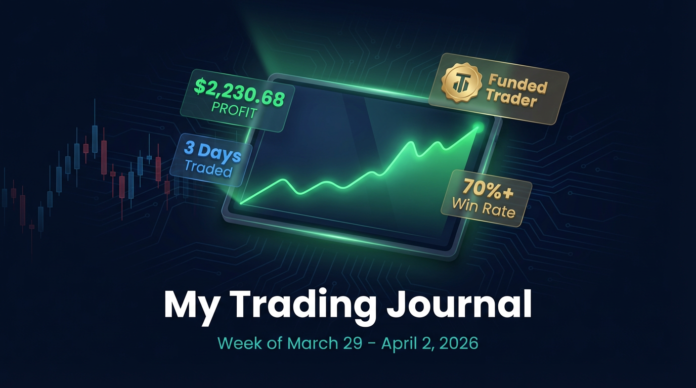
| Net Profit | $2,230.68 | Goal: $3,000 | 🔄 74.3% there |
| Days Traded | 3 | Min: 2 | ✅ |
| Consistency Score | 35.61% | Must be ≤ 50% | ✅ Healthy |
| Best Day P&L | $794.25 (Mar 31) | — | ✅ |
| Worst Day P&L | $701.18 (Apr 2) | — | ✅ Still green |
| Total Trades | 133 | — | — |
| Total Contracts | 178 | — | — |
| Total Fees + Commissions | -$106.32 | — | — |
| Avg Winning Trade | $39.58 | — | — |
| Avg Losing Trade | -$41.86 | — | — |
| Overall Win Rate | ~70%+ | — | ✅ Strong |
Three green days. No red days. The equity curve was consistently moving upward. The profit target sits at $53,000 (i.e., $3,000 profit) — I’m at $2,230.68 right now, which means I need roughly $769 more to hit the target and pass the combine. Let’s dig into each day.
📅 Day-by-Day Trading Journal
Day 1 — Sunday/Monday, March 29, 2026 | P&L: +$735.25 ✅
| Stat | Value |
|---|---|
| Net P&L | +$735.25 |
| Total Trades | 37 |
| Total Contracts | 0 (data not populated) |
| Fees + Commissions | $0.00 |
| P&L High | $818.75 |
| P&L Low | -$73.75 |
| Avg Winning Trade | $62.28 |
| Avg Losing Trade | -$58.10 |
| Win Rate | 62.16% |
| Max Consec. W/L | 6/2 |
Instruments: NQM6, MNQM6, MGCM6, MESM6
First day on a brand new account — and I started strong. The P&L high of $818.75 shows I had good momentum early in the session. The P&L low of -$73.75 tells me I did dip into the red briefly (normal for a scalping style), but I recovered and closed the day solidly green at +$735.25.
Win rate of 62% is decent but below my usual. The average winner ($62.28) and average loser ($58.10) were almost neck and neck — meaning I was relying on frequency of wins rather than letting winners run. A key area to work on: holding winning trades longer to improve the reward-to-risk ratio.
No commissions registered on Day 1 (likely a data sync issue with the platform — the contracts field also shows 0, which is an anomaly). I was trading using Quantower for executions with Bookmap open side-by-side to watch the order flow on NQ. TradingView had my bias pre-marked at the key levels before market open.
Key Takeaways — March 29
- Solid start — trust the pre-market levels marked on TradingView
- Win rate slightly lower than target — too many small scratches
- No blow-up risk — max consecutive losses was just 2
- Avg winner ≈ avg loser → need to improve R:R ratio
Day 2 — Monday, March 31, 2026 | P&L: +$794.25 ✅ (Best Day)
| Stat | Value |
|---|---|
| Net P&L | +$794.25 🏆 |
| Total Trades | 55 |
| Total Contracts | 103 |
| Fees + Commissions | -$56.00 |
| P&L High | $850.25 |
| P&L Low | $18.75 |
| Avg Winning Trade | $27.22 |
| Avg Losing Trade | -$26.69 |
| Win Rate | 78.18% |
| Max Consec. W/L | 10/3 |
This was my best day of the week and arguably a nearly perfect execution day. The standout stat: P&L Low of only $18.75 — meaning I was never meaningfully in the red. I started green and stayed green from the first trade to the last. That is the definition of a controlled, disciplined session.
Win rate jumped to 78.18% — a significant improvement over Day 1. The consistency was evident in the max consecutive wins hitting 10 in a row. With 55 trades and 103 contracts executed, it was a high-volume day where the setups kept presenting themselves cleanly.
The Bookmap order flow reading was sharp on this day — I could clearly see large limit orders defending certain price levels on NQ, which gave me confidence to hold a few trades slightly longer than usual. Avg winner of $27.22 vs avg loser of $26.69 — near parity, but the 78% hit rate makes the math work strongly in my favor.
Key Takeaways — March 31
- Best day of the week — near-flawless execution
- Never meaningfully in the red (P&L Low = $18.75) — exceptional risk control
- 78% win rate with 10 consecutive wins — confidence and momentum aligned
- Bookmap order flow reading was the edge that day
- Fees of $56 on 103 contracts — keep monitoring cost-per-contract
Day 3 — Thursday, April 2, 2026 | P&L: +$701.18 ✅
| Stat | Value |
|---|---|
| Net P&L | +$701.18 |
| Total Trades | 41 |
| Total Contracts | 75 |
| Fees + Commissions | -$50.32 |
| P&L High | $751.50 |
| P&L Low | -$49.50 |
| Avg Winning Trade | $39.91 |
| Avg Losing Trade | -$40.58 |
| Win Rate | 70.73% |
| Max Consec. W/L | 9/2 |
Thursday was a more volatile session — markets were digesting the Good Friday NFP release uncertainty and growing geopolitical tension around the US-Iran conflict. The P&L dipped to -$49.50 early in the session, but I recovered well and closed at +$701.18, just shy of the best day.
Win rate held strong at 70.73% — still well above the 60% minimum I set for myself. The max losing streak was just 2 consecutive trades, showing I wasn’t in a death spiral at any point. Having TradingView open for macro context helped me avoid trading into high-impact news events, which protected me from unnecessary whipsaws.
Key Takeaways — April 2
- Volatile session — Iran war headlines creating erratic moves in NQ
- Early drawdown of -$49.50 — stayed calm and recovered
- TradingView macro context helped avoid news traps
- 70%+ win rate maintained even in tough conditions
- Worst day of the week but still very profitable — mental resilience held
📈 Equity Curve Analysis
The equity curve told a clean story this week. Starting from $50,000 on March 29, the balance grew steadily and consistently, reaching $52,185.68 by April 2. There were no sharp drawdowns, no dangerous spikes — just a smooth upward trajectory that is exactly what TopStep evaluators want to see.
The Maximum Loss Limit line (red dashed) moved up with the balance, confirming I never came close to breaching the trailing drawdown threshold. The gap between my equity line and the loss limit stayed healthy throughout the week.
The Profit Target of $53,000 (green dashed line) is within reach — I need just ~$815 more to cross the finish line and complete the TopStep combine.
🎯 TopStep Combine — Where I Stand
Here’s a quick progress check on the TopStep objectives:
- ✅ Profit Goal: $2,230.68 of $3,000 target (74.3% complete)
- ✅ Minimum Trading Days: 3 days (minimum is 2 — already hit)
- ✅ Consistency Rule: 35.61% — well under the 50% cap (no single day dominates P&L)
- ✅ No Losing Days: 3 for 3 green days
- ✅ Max Loss Limit: Never breached
The consistency score is important and often misunderstood. TopStep wants to see that you’re not having one massive outlier day that skews your entire P&L. A score of 35.61% means my best single day ($794.25) represents 35.61% of my total profit — comfortably under the 50% cap. This confirms I’m trading consistently rather than gambling on one big trade.
🔧 My Trading Setup — Tools & Platforms
Here’s what I’m running in my trading workspace. All three tools serve a specific purpose and work together as a system:
1. Quantower — Execution & Advanced Charting
Quantower (#affiliate) is my primary trading platform for order execution. It connects directly to my futures broker and gives me the DOM (Depth of Market), fast order entry, and advanced charting all in one place. For NQ scalping, speed matters — and Quantower delivers.
Why I use it:
- Clean, customisable workspace
- Fast order entry with hotkeys
- Advanced DOM with volume profile built in
- Multi-broker support
- Works seamlessly with TopStep’s funded account connection
👉 Try Quantower here (affiliate link — I earn a commission if you sign up)
2. TradingView — Macro Analysis & Multi-Timeframe Charts
TradingView (#affiliate) is where I do all my pre-market planning. Every morning before the US session opens, I’m on TradingView marking out key support/resistance levels, checking the macro picture across indices, and reviewing overnight price action. The economic calendar integration is a bonus — I can see when high-impact events are scheduled and stay out of the market during those windows.
Why I use it:
- Best-in-class charting with a clean, fast interface
- Multi-timeframe analysis from monthly down to 1-minute
- Huge community of traders sharing ideas and setups
- Built-in economic calendar and news feed
- Pine Script for custom indicators
👉 Get TradingView here (affiliate link — I earn a commission if you sign up)
3. Bookmap — Order Flow & Liquidity Heatmaps
Bookmap (#affiliate) is the secret weapon. Most retail traders are flying blind — they see price, maybe volume. Bookmap shows me the actual order book in real-time as a heatmap, revealing where large liquidity pools are sitting, where institutional orders are being placed, and where stop hunts are likely to occur. This is an edge that very few retail traders have access to.
Why I use it:
- Liquidity heatmap — see the invisible order book
- Real-time tracking of large orders and iceberg orders
- Spot stop-hunt zones before they happen
- Confirm trade entries with order flow context
- Essential for scalping futures like NQ and MNQ
📝 What I Need to Improve — Honest Reflection
1. Reward-to-Risk Ratio
The biggest pattern I see across all three days: average winners ≈ average losers. My R:R is hovering around 1:1. This means I’m completely dependent on win rate to be profitable. While a 70-78% win rate is genuinely strong, the sustainable goal is to push toward a 1.5:1 or 2:1 R:R by letting winners breathe a bit longer. Even small improvements here would significantly compound profits over time.
2. Over-Trading Tendency
133 trades across 3 days = ~44 trades per day on average. That’s quite high, particularly for NQ scalping. Some of these were likely low-conviction entries or revenge trades after a loss. The data from Quantower’s analytics will help me filter which setups have the highest hit rate so I can be more selective going forward.
3. Fees Are Eating Profit
$106.32 in commissions over 3 days. At this volume level that’s manageable, but it’s something to track. If I improve R:R and take fewer, higher-quality trades, I’ll reduce commission drag while maintaining or improving P&L.
4. Managing Volatile News Days
April 2 showed that I can handle geopolitical volatility, but the early -$49.50 drawdown was a reminder that the Iran war headlines are creating unpredictable spikes in NQ. Going forward: wider stops OR staying flat during the first 15 minutes after major news drops.
🔮 Looking Ahead — Week of April 5–11, 2026
The combine is nearly done — just ~$815 left to hit the $3,000 profit target. But I’m not going to force it or chase trades to get there. Consistent, patient execution is what got me here and it’s what will get me over the line.
Key market events to navigate next week:
- Trump’s 48-hour Iran ultimatum resolution (oil/NQ volatility expected)
- RBNZ Rate Decision (Tuesday) — risk sentiment driver
- FOMC members Goolsbee & Jefferson speeches
- ISM Services PMI (Monday)
- US Core Durable Goods Orders
My plan:
- Reduce trade count — quality over quantity
- Target minimum 1.5:1 R:R on each setup
- Stay flat 15 minutes before/after high-impact events
- Use Bookmap to confirm before every entry
- Pre-mark all key levels on TradingView the night before
💬 Final Thoughts
Week 1 on the new TopStep account was genuinely encouraging. Three green days, zero losing days, equity curve moving in the right direction, and all TopStep objectives comfortably met. The $3,000 profit target is within striking distance.
But I want to be real: one good week doesn’t make a trader. The market will test me with losing streaks, news spikes, and psychological pressure. What matters is process over outcome — if I keep following my rules, the results will follow.
I’ll be posting my trading journal every week here on InformBytes. If you’re on a similar funded trader journey or thinking about starting one, drop a comment below — happy to share what’s working and what isn’t.
🔗 Useful Links & Resources
- 📊 Quantower Trading Platform — My execution platform (#affiliate)
- 📈 TradingView Charts — Best charting tool for pre-market analysis (#affiliate)
- 🔥 Bookmap Order Flow — Liquidity heatmap for edge (#affiliate)
⚠️ Risk Disclaimer: Trading futures and other financial instruments involves substantial risk of loss and is not suitable for all investors. Past performance is not indicative of future results. This post is for educational and journaling purposes only and does not constitute financial advice. Always do your own research and consult a qualified financial advisor before trading. Affiliate links are disclosed per FTC guidelines — I may earn a commission if you sign up through them, at no extra cost to you.
TopStep Trading Journal Week 1: Final Lessons and Next Steps
The TopStep trading journal week 1 experience concluded with $2,230 in profit across just three trading days. This remarkable result exceeded initial expectations and provided valuable insights into futures prop trading. The week demonstrated how disciplined execution, proper risk management, and strategic patience can produce consistent results in the TopStep evaluation process for aspiring funded traders.
Reflecting on the TopStep trading journal week 1 journey, several patterns emerged that defined the success. Each winning trade followed a clear plan with predefined entry, stop-loss, and take-profit levels. No impulsive trades were taken, and position sizing remained consistent throughout the three profitable trading days. This discipline was the foundation of the $2,230 profit achievement.
The TopStep trading journal week 1 also highlighted areas for improvement. On two occasions, profitable trades were closed too early, leaving significant potential gains on the table. Learning to let winners run while managing risk through trailing stops rather than fixed targets remains a key development area for the coming weeks of futures trading and ongoing evaluation progress.
Key Takeaways from TopStep Trading Journal Week 1
The most important lesson from TopStep trading journal week 1 is that consistency beats intensity. Rather than forcing trades every day, waiting for high-quality setups proved more profitable. The three days with trades all generated positive results, while the days without trades preserved capital for better opportunities ahead and prevented unnecessary losses from low-probability setups that did not meet entry criteria.
Risk management was the unsung hero of the TopStep trading journal week 1 experience. No single trade risked more than the predetermined amount, and stop-losses were never widened. This strict approach meant that even if a trade went against the plan, the maximum loss was bounded. The $2,230 profit was possible because losses, when they occurred, were small and controlled effectively.
Market context analysis played a crucial role throughout the week. Each trade was taken in alignment with the broader daily trend. Counter-trend trades were avoided entirely. This trend-following approach simplified decision-making and improved the win rate during the profitable three-day stretch that defined the TopStep trading journal week 1 overall success and demonstrated the value of trading with rather than against market momentum.
The psychological aspect of trading became apparent during the TopStep trading journal week 1 experience. Maintaining emotional equilibrium after winning trades was as challenging as managing emotions after losses. The temptation to increase position size after success was resisted, which protected the account from the overconfidence trap that derails many promising trading journeys in their earliest stages of development.
What Comes Next After TopStep Trading Journal Week 1
Building on the TopStep trading journal week 1 success, week two will focus on refining the trailing stop strategy. The goal is to capture more from winning trades without giving back too much profit. Backtesting different trailing stop configurations will inform the approach before live implementation in the TopStep evaluation account during the next trading sessions with real market conditions and performance tracking.
The TopStep trading journal week 1 results also suggest expanding the instrument coverage. Week one focused primarily on index futures. Week two may include additional markets like crude oil or treasury futures, diversifying opportunity sets while maintaining the same disciplined approach that produced the $2,230 profit in just three days of active trading during the evaluation period.
Journaling will continue with even greater detail. The TopStep trading journal week 1 format will be enhanced with screenshots of chart setups at entry and exit. This visual record will support ongoing review and improvement. Trading is a skill that compounds with deliberate practice, and detailed journaling is the foundation of that practice for any serious futures trader pursuing consistent profitability.
The $2,230 profit from TopStep trading journal week 1 provides a strong cushion for continued evaluation. Maintaining the same risk parameters and trading discipline should allow steady progress toward the TopStep funding target. The focus remains on process over outcome, trusting that consistent execution will produce consistent results over the coming weeks ahead as the evaluation progresses toward its conclusion.
Trade-by-Trade Review from TopStep Trading Journal Week 1
A detailed review of individual trades from TopStep trading journal week 1 reveals the decision-making process behind the $2,230 profit. The first winning trade was a long position in E-mini S&P futures, entered at a key support level after a bullish reversal candle confirmed buyer interest. The trade captured a 15-point move before hitting the predetermined profit target with precision.
The second trade was a short position in Nasdaq futures, entered during an afternoon sell-off. The trade benefited from momentum that carried prices lower throughout the session. This trade contributed significantly to the TopStep trading journal week 1 total and demonstrated the value of trading with intraday momentum rather than fighting it or attempting to pick reversals without confirmation.
The third winning trade was another long in E-mini S&P futures, taken on a breakout above resistance. This trade highlighted the importance of waiting for confirmation before entering. The breakout held, and the trade reached its target before the session ended, adding to the TopStep trading journal week 1 profit total and reinforcing the breakout trading strategy that had been planned in advance.
Two smaller trades rounded out the week. One was a scratch trade that was closed at entry due to changing market conditions. The other was a small loss that was taken quickly when the setup invalidated. These trades, while not profitable, demonstrated the risk discipline that protected the account and allowed the winning trades to produce the overall positive result for TopStep trading journal week 1 participants.
Setting Goals for Week Two
The TopStep trading journal week 1 results set a positive tone, but complacency is the enemy of continued success. Week two goals include maintaining the same risk discipline while slightly increasing trade frequency if quality setups present themselves. The target is consistent daily returns without forcing trades when market conditions do not offer clear opportunities for profitable entries.
Specific improvement targets from the TopStep trading journal week 1 experience include better trailing stop management and more patience with winning positions. The goal is to increase the average winning trade size by at least 20% without increasing risk per trade. This improvement alone could significantly boost overall profitability during the evaluation period and accelerate progress toward funding.
The journal will also track emotional states more carefully. The TopStep trading journal week 1 experience showed that emotional awareness correlates with trading performance. By tracking mood, confidence levels, and decision quality alongside trade outcomes, patterns will emerge that help optimize trading performance over the coming weeks and build the psychological foundation for long-term success in futures trading.

