
Table of Contents

Photo by NastyaSensei via Pexels
Introduction: The New Cold War Playing Out in Silicon and Software
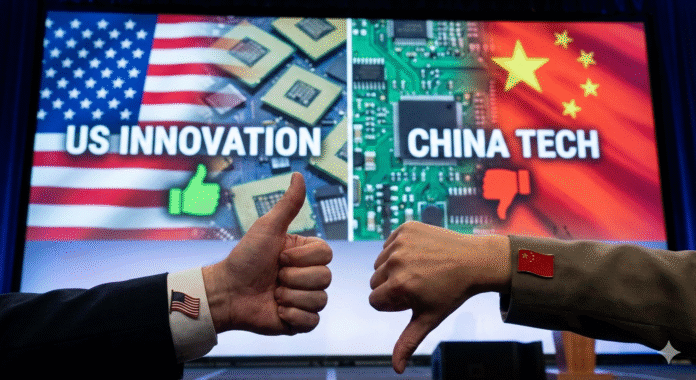
The US-China technology rivalry has intensified dramatically in 2025, evolving from trade disputes into comprehensive competition for technological supremacy. From semiconductor restrictions to AI development, the world’s two largest economies are locked in an “AI Cold War” with profound implications for global innovation and economic growth.The 2025 Technology Battleground: Key Conflict Areas
1. Semiconductor Supremacy: The Foundation of Tech Power
US Export Controls Tighten:- Advanced chip manufacturing equipment (EUV lithography) banned
- AI-capable GPU exports heavily restricted
- Design software and EDA tools require licenses
- Outbound investment screening for US capital in Chinese semiconductor firms
- $150+ billion committed to domestic chip production
- Rare earth export restrictions (gallium, germanium, graphite)
- Focus on alternative architectures (chiplets, 3D integration)
2. Artificial Intelligence: The Strategic Technology Race
DeepSeek’s January 2025 Breakthrough:China’s DeepSeek released an LLM achieving GPT-4-comparable performance using significantly fewer computational resources, demonstrating Chinese AI capabilities advancing despite semiconductor restrictions. US AI Leadership Strategy:
- Export controls preventing adversary AI advancement
- OpenAI’s $38 billion AWS agreement for massive capacity
- Anthropic’s $50 billion U.S. data center buildout
Domestic Debates in China: Economic “Involution”
Chinese domestic debates reveal concern about economic “involution”—cutthroat competition and unsustainable price wars driven by overcapacity. Manifestations:- E-commerce platforms in subsidy-driven price wars
- Local governments racing to subsidize same industries
- Companies tolerating losses for market share
Global Impact: Technology Markets Fracture
The Emerging Bipolar Technology World
Western Ecosystem:- US cloud platforms (AWS, Azure, Google Cloud)
- American AI models (OpenAI, Anthropic, Google)
- Allied semiconductor supply chains
- Chinese cloud platforms (Alibaba, Huawei)
- Domestic AI models (DeepSeek, Baidu, Alibaba)
- Alternative standards and protocols
2026 Outlook: What to Expect Next
Base Case (60% Probability): Managed Competition
- Continued tensions without catastrophic escalation
- Strategic decoupling in critical technologies continues
- Trade remains substantial despite restrictions
Escalation Scenario (25% Probability)
- Taiwan contingency triggering comprehensive sanctions
- Complete technology decoupling
- Economic disruption at pandemic scale
Conclusion: Technology Competition Reshaping Global Order
The US-China technology war has transcended trade policy to become a defining feature of 21st-century geopolitics. As both nations pursue technological self-sufficiency, the global technology landscape is fracturing into competing ecosystems. Organizations must redesign supply chains with geopolitical resilience, develop scenario planning for multiple futures, and adapt to increasing compliance burdens as regulations proliferate.Sources: Merics, Atlantic Council, ITIF, Wall Street Journal, AEI, El País
The Escalation of US China Tech War 2025
The global technology landscape underwent fundamental transformation as tensions between the world’s two largest economies reached unprecedented intensity. This comprehensive conflict reshaped semiconductor supply chains, artificial intelligence development, and international trade relationships. Companies worldwide found themselves navigating an increasingly complex geopolitical environment with far-reaching implications.
This conflict represented far more than traditional trade disputes. It embodied a fundamental struggle for control over the technologies that will define the next century. Quantum computing, artificial intelligence chips, next-generation telecommunications, and advanced manufacturing all became battlegrounds in this comprehensive technological competition between rival economic systems.
Stakes extended beyond economics into national security and global influence. Both nations recognized that technological leadership would determine geopolitical power for decades to come. Consequently, policy decisions made during this period will influence international relations well into the future, affecting alliances, trade patterns, and military capabilities worldwide.
Third-party nations faced difficult choices as the conflict intensified. Countries that had maintained neutral technology relationships found themselves pressured to align with one system or the other. This dynamic reshaped diplomatic relationships across Asia, Europe, Africa, and Latin America as technology decisions acquired geopolitical significance they had not previously carried.
Key Events Shaping the Technological Rivalry
Several pivotal events defined the escalation. The United States expanded entity list restrictions, cutting more Chinese companies from critical technology supply chains. Semiconductor restrictions tightened to include advanced packaging technologies that had previously escaped export control measures, closing loopholes that Chinese firms had exploited.
China responded by accelerating domestic chip development programs with massive government-backed investments. State funds poured into local semiconductor manufacturers through multiple funding rounds. The restrictions paradoxically stimulated China’s determination to achieve technological self-sufficiency, potentially reducing long-term effectiveness of export controls as alternative supply chains matured.
The conflict also targeted artificial intelligence infrastructure. New restrictions limited Chinese access to advanced GPUs used for training large language models. This move aimed to slow China’s AI military applications while simultaneously affecting commercial AI development across numerous Chinese technology companies and research institutions.
Diplomatic tensions spilled into international forums. Both nations competed for influence in standards-setting bodies, trade organizations, and bilateral relationships with third countries. The technological rivalry became a central theme in global diplomacy throughout the year, dominating summit agendas and bilateral meetings that had previously focused on traditional security and trade topics.
Space technology emerged as another competition dimension within the ongoing technological conflict. Both nations accelerated satellite deployment programs and lunar exploration missions. Commercial space companies found themselves subject to national security restrictions that limited international collaboration and technology sharing across borders.
Semiconductor Restrictions Define the Conflict
Semiconductor policy stood at the heart of the technological confrontation. The United States imposed sweeping export controls on advanced chips, manufacturing equipment, and electronic design automation software. These restrictions affected industry leaders including NVIDIA, AMD, ASML, and Applied Materials directly, requiring complex compliance programs and rapid business model adjustments.
NVIDIA faced particularly significant challenges. The company had to create modified chip versions specifically for the Chinese market to comply with new regulations. Revenue impacts were substantial, with billions in potential sales at risk. Other semiconductor companies faced similar dilemmas, balancing compliance with revenue preservation while maintaining relationships with Chinese customers.
The restrictions created a two-tier global semiconductor market. Advanced chips became available only to approved nations while restricted countries developed alternative supply chains. This bifurcation threatened to fragment the global technology ecosystem that had driven innovation for decades through shared standards and open trade.
Equipment manufacturers faced particularly complex restrictions. Lithography machines essential for advanced chip production became diplomatic tools. The Netherlands and Japan, home to critical equipment makers, faced intense diplomatic pressure to align their export controls with American policies, creating tensions within long-standing trade relationships.
How the US China Tech War 2025 Reshaped Chip Markets
The restrictions fundamentally altered semiconductor market dynamics. Chinese companies stockpiled chips before restrictions took full effect, creating temporary demand surges. Some component categories experienced shortages while others saw overproduction as supply chains adjusted to new realities and companies recalibrated their procurement strategies.
Global semiconductor supply chains restructured rapidly. Companies adopted China-plus-one strategies, moving manufacturing operations to Vietnam, India, Malaysia, and Mexico. This diversification required substantial capital investment and years of development to achieve operational maturity comparable to established Chinese facilities that had benefited from decades of investment.
Taiwan’s position remained precarious throughout the conflict. As the world’s leading advanced chip manufacturer through TSMC, Taiwan became central to strategic calculations. Both nations increased military and diplomatic posturing in the region, raising concerns about potential supply chain disruption from geopolitical events that could cascade through the global economy.
Japanese and South Korean semiconductor companies navigated complex diplomatic pressures. These nations hosted critical links in the semiconductor supply chain but maintained significant economic relationships with both competing powers. Their policy responses influenced the effectiveness of broader restriction frameworks and created diplomatic fault lines.
Chip design software became another restriction target within this technological rivalry. Electronic design automation tools from American companies dominated the global market, and restricting Chinese access hampered domestic chip development capabilities. Chinese firms invested heavily in developing alternative design tools, though significant capability gaps remained.
Artificial Intelligence as a Primary Battleground
Artificial intelligence emerged as a primary front in the rivalry. The United States restricted access to AI training chips while China poured resources into domestic AI development programs. Policies targeted both hardware components and software ecosystems that enabled advanced AI research and commercial deployment across multiple application domains.
The AI restrictions affected large language model development directly. Chinese AI companies struggled to obtain sufficient compute resources for training frontier models comparable to Western offerings. Several promising Chinese AI startups pivoted toward more efficient model architectures to compensate for hardware limitations imposed by export controls.
Beyond hardware, the conflict extended to AI talent. Both nations implemented policies to attract and retain top AI researchers. Visa restrictions complicated international collaboration in artificial intelligence research, potentially fragmenting the global scientific community that had driven AI progress through open collaboration and knowledge sharing.
AI safety and governance approaches diverged significantly. The United States emphasized voluntary commitments and market-driven standards. China implemented strict regulatory requirements with government oversight. These divergent approaches created compliance challenges for multinational companies operating AI systems across both jurisdictions with conflicting requirements.
Chinese AI Resilience Despite Restrictions
Despite restrictions, Chinese AI companies demonstrated remarkable resilience. Firms like DeepSeek, Alibaba, and Baidu released competitive models using fewer computational resources through innovative training techniques. The restrictions inadvertently drove innovation in efficient AI architectures and training methodologies that might not have emerged otherwise.
China’s approach to AI restrictions included massive state investment in domestic GPU development. While Chinese chips initially lagged behind NVIDIA’s offerings in performance, the gap narrowed steadily through targeted investment and engineering talent recruitment. Long-term implications for global AI competition remain uncertain as alternative hardware platforms mature.
Chinese researchers also explored alternative computing paradigms including neuromorphic chips and photonic processors. These approaches, if successful, could eventually circumvent restrictions designed around conventional GPU architectures. The innovation response demonstrated how restrictions can stimulate rather than suppress technological development when targeted nations possess sufficient resources.
Open source AI models became a contentious area within the US China tech war 2025. Chinese companies released open source models that gained global adoption, raising questions about influence and potential security risks. The open source approach allowed Chinese developers to build international ecosystems around their models despite hardware restrictions.
Market Impact Across Global Technology Sector
Economic consequences rippled through global markets throughout the year. Technology stocks experienced heightened volatility as policy announcements shifted investor sentiment overnight. Uncertainty caused many companies to delay expansion plans, reduce capital expenditure, and reconsider international strategies that had assumed continued globalization.
Chinese technology stocks listed in the United States faced delisting risks under new audit requirements. The potential forced separation of Chinese companies from American capital markets represented a fundamental restructuring of global technology finance. Institutional investors reassessed exposure to companies with significant cross-border dependencies and complex ownership structures.
Currency markets also reflected tensions. The Chinese yuan experienced pressure during escalation periods, while the dollar strengthened as a safe haven. These financial dynamics added economic dimensions to what began as technology policy disputes, creating feedback loops between technology restrictions and broader financial market stability.
Supply chain costs increased significantly. Companies maintaining parallel supply chains for different markets reported 15-25% higher operational costs. These expenses ultimately passed to consumers through higher technology product prices, making the technological rivalry a tangible economic factor for ordinary citizens worldwide.
Technology Companies Navigate Complex Landscape
Major technology companies developed sophisticated strategies to navigate the divided landscape. Apple accelerated production shifts to India despite significant manufacturing challenges and quality concerns. Supply chain diversification required substantial capital investment and patient development of new supplier ecosystems capable of meeting quality standards.
Cloud providers split their infrastructure to comply with data sovereignty requirements. Microsoft and Amazon maintained separate Chinese cloud regions operated by local partners. This operational complexity increased costs and limited feature parity between regions, affecting customer experience globally and creating competitive disadvantages for affected services.
Smaller companies faced disproportionate challenges. Startups with international teams struggled to navigate conflicting regulations. The environment rewarded companies with strong compliance capabilities, legal resources, and deep capital reserves. Many smaller firms exited either the American or Chinese market entirely, reducing global competition and innovation.
Geopolitical Dimensions and Global Alliances
The US China tech war 2025 extended beyond economics into geopolitics. Allies faced pressure to align with either American or Chinese technology ecosystems. Diplomatic efforts required nations to make difficult choices about telecommunications infrastructure, semiconductor sourcing, and technology standards adoption that would determine their technological trajectories for decades.
The Huawei 5G debate intensified as countries that had delayed decisions were forced to choose sides. Several European nations implemented partial bans on Chinese telecommunications equipment. The choices these nations made would influence their technology landscapes for decades given long infrastructure lifecycles and switching costs.
The United States strengthened technology alliances through partnerships with Japan, South Korea, and the Netherlands. These relationships proved critical for implementing effective semiconductor restrictions. The diplomatic coordination required represented unprecedented cooperation among allied nations on technology policy and export control harmonization.
China cultivated its own partnerships through the Belt and Road Initiative, incorporating digital infrastructure projects across Asia, Africa, and Latin America. Competition extended to developing nations as both powers sought technology influence through investment, training, and infrastructure development that would bind recipient nations to their technology ecosystems.
Future Trajectory Beyond 2025
Looking beyond the current conflict, decoupling appears increasingly likely. Technology ecosystems may bifurcate into distinct spheres with incompatible standards, separate supply chains, and limited interoperability. The rivalry planted seeds for a fundamentally different global technology landscape that future generations will inherit and navigate.
Companies must prepare for continued tensions. Diversified supply chains, robust compliance programs, and scenario planning remain essential capabilities. Geopolitical risk has become a core business consideration rather than a peripheral concern for technology companies worldwide, requiring new organizational competencies and strategic thinking.
The US China tech war 2025 will reshape how technology is developed, deployed, and governed worldwide. Organizations that understand these dynamics and adapt proactively will navigate the coming years successfully. Those that ignore geopolitical realities face significant operational and strategic risks as the divided landscape evolves and new fault lines emerge between competing technology spheres.
Ultimately, this technological rivalry may accelerate innovation in both nations while fragmenting the global cooperation that has historically driven scientific progress. The balance between competitive stimulation and collaborative loss will define the trajectory of global technology development for decades to come, making this period a watershed moment in international technology relations.
Emerging Technologies and Future Competition
Beyond semiconductors and AI, the rivalry extended to emerging technologies with long-term strategic implications. Quantum computing research became a focal point, with both nations investing heavily in quantum advantage development. The first nation to achieve practical quantum computing would gain unprecedented capabilities in cryptography, materials science, and optimization problems with military applications.
Biotechnology emerged as another competition frontier. Genomic editing, synthetic biology, and pharmaceutical development all received increased government funding and strategic priority. Both nations recognized that biotechnology leadership would determine healthcare independence and potential military biodefense capabilities for decades to come.
Quantum communication networks represented a particular area of Chinese investment. China launched quantum satellites and developed ground-based quantum networks ahead of American efforts. This leadership in quantum communication could provide advantages in secure military communications that traditional encryption cannot guarantee against future quantum computing threats.
The rivalry also extended to clean energy technologies. Solar panel manufacturing, battery technology, and electric vehicle development all became arenas of competition. Chinese dominance in solar manufacturing created dependencies that Western nations sought to reduce through alternative supply chains and domestic production incentives despite significant cost disadvantages.
Autonomous systems competition intensified across multiple domains. Self-driving vehicle technology, autonomous maritime vessels, and drone swarms all received strategic investment from both nations. Military applications of autonomous systems created particular concern, as the nation achieving breakthrough capabilities could fundamentally alter battlefield dynamics in future conflicts.

