Table of Contents
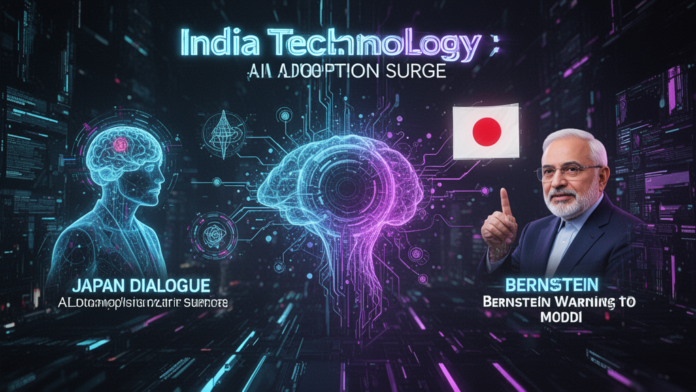
India is the world’s most aggressive major-economy adopter of artificial intelligence in April 2026 — with 40% of enterprise respondents reporting significant or full AI use, against a global average of 28%. But Bernstein’s open letter to PM Modi warns that India risks becoming a “permanent consumer” of global AI rather than a creator, while India and Japan deepen bilateral tech cooperation and the IndiaAI mission accelerates government digitization. Here is the complete India technology update for late April 2026.
India Leads Global Enterprise AI Adoption
India has emerged as the most aggressive adopter of AI among major economies. Nearly 40% of Indian enterprise respondents report significant or full use of AI in their operations — well ahead of the global average of 28%. Sectors driving adoption: IT services (building AI-native delivery models), BFSI (fraud detection, credit underwriting), healthcare (diagnostic AI, administrative automation), and e-commerce (personalization, supply chain optimization). The adoption rate reflects both India’s large technology talent base and the cost sensitivity that makes AI automation economically compelling at lower wage rates than Western markets.
Bernstein’s Warning to Modi: Build or Stay Consumer
Global brokerage Bernstein published an open letter to Prime Minister Narendra Modi in April 2026, flagging risks around AI-driven job displacement and India’s structural position in the global AI value chain. The core warning: if Indian data continues to be used to train global AI models (OpenAI, Anthropic, Google) without India building its own frontier AI capabilities, India becomes a permanent consumer in the AI economy — benefiting from AI tools but capturing none of the economic value from owning the technology stack.
Bernstein called for urgent investment in compute infrastructure (India has less than 1% of global AI training compute capacity), domestic AI model development, and stronger data governance frameworks that give India leverage over how its data is used globally. The letter specifically warns that AI-driven automation threatens India’s service export model — if AI agents can do the work that India’s IT services sector does for Western corporations, the $250 billion annual IT exports that underpin India’s current account balance are at risk over a 3-5 year horizon.
India-Japan AI Strategic Dialogue: A New Tech Partnership
India and Japan held their first Artificial Intelligence Strategic Dialogue in Mumbai on April 21, 2026 — a significant step in deepening bilateral technology cooperation. The dialogue focused on three areas: semiconductor supply chain resilience (Japan’s advanced semiconductor industry and India’s growing chip design talent complement each other), AI research collaboration (joint funding for AI safety and governance research), and digital public infrastructure (Japan’s interest in deploying India’s DPI stack — UPI, Aadhaar, ONDC — in developing economies with which Japan has aid relationships).
IndiaAI Mission: Government AI Capacity Building Scales
The IndiaAI mission is accelerating AI capacity building across the Indian government. The National e-Governance Division has empanelled multiple AI/ML talent providers — including Cactus Technology Solutions in April 2026 — as partner agencies for government-led digital initiatives. The mission is advancing the Viksit Bharat (Developed India) vision through AI-enabled government services: AI-powered land record management, AI-assisted judicial processes, and AI-enhanced agricultural advisory services are all in various stages of deployment.
The Challenge: Deep Technical Expertise Lags Adoption
BusinessToday’s April 2026 analysis captures the core tension: “India is racing ahead in AI adoption but falling behind where it matters.” While usage rates are high, India’s contribution to frontier AI research — published papers, leading models, compute infrastructure — remains disproportionately small relative to its talent base. The April 2026 AI Governance Panel for startups noted that until recently, AI startups operated in a regulatory vacuum with no statutory definition of an “AI system,” creating uncertainty that has deterred some forms of domestic AI investment. The AIGEG advisory body is working to close this gap, but structural compute and research investment gaps will take years to address.
India AI Technology April 2026: A Nation at the Forefront
The India AI technology April 2026 landscape has positioned the country as a surprising global leader in enterprise AI adoption. With 40% of Indian enterprises reporting active AI deployment, India has surpassed the global average and drawn attention from investors, policymakers, and technologists worldwide.
This surge is not accidental. India AI technology April 2026 reflects years of deliberate investment in digital infrastructure, a massive engineering talent pool, and a government that has embraced AI as a national priority. The convergence of these factors created fertile ground for rapid adoption.
What Drove India AI Technology April 2026 Adoption Rates
Several catalysts explain the India AI technology April 2026 adoption surge. First, the proliferation of affordable cloud computing through domestic and international providers lowered the cost barrier for enterprise experimentation. Companies that could not afford dedicated GPU clusters now access AI capabilities through pay-as-you-go services.
Second, India AI technology April 2026 benefits from a deep talent reservoir. Indian engineers have been central to global AI development for years, and many are now returning home or launching domestic startups. This brain circulation has transferred world-class expertise into the local ecosystem.
Third, the regulatory environment has been relatively permissive compared to the European Union. India AI technology April 2026 adoption has flourished because companies can iterate and deploy without the compliance overhead that slows European competitors, while still operating within a framework that addresses key safety concerns.
Bernstein’s Warning to Modi: A Cloud Over India AI Technology April 2026
Amid the optimism, the India AI technology April 2026 narrative includes a cautionary note from global brokerage firm Bernstein. In a widely circulated research note, Bernstein warned the Modi government that India’s AI ambitions risk being undermined by inconsistent policy execution, infrastructure gaps, and over-reliance on foreign model providers.
The Bernstein analysis, which became a flashpoint in India AI technology April 2026 discussions, argued that while adoption rates are impressive, India remains largely a consumer of AI technology rather than a producer. The concern is that without domestic foundational model development, India risks becoming technologically dependent on a handful of foreign labs.
The report recommended that India AI technology April 2026 policy should prioritize three areas: subsidizing compute infrastructure for domestic researchers, creating sovereign datasets for training, and incentivizing Indian companies to build rather than just deploy. The government has signaled openness to these recommendations.
India AI Technology April 2026 and the Talent Paradox
Bernstein also highlighted what the India AI technology April 2026 data reveals about the talent paradox. While India produces an enormous number of engineering graduates, the supply of AI-specialized researchers remains thin. Most top AI talent still migrates to the United States or Europe for better compensation and research opportunities.
India AI technology April 2026 adoption numbers may therefore mask a fragility: companies are deploying AI, but the deep technical talent needed to maintain and advance these systems is concentrated abroad. Retaining and attracting top researchers will be essential if India wants to move from consumer to producer.
India-Japan AI Dialogue: A Strategic Pillar of India AI Technology April 2026
A major diplomatic development in the India AI technology April 2026 cycle was the formalization of an India-Japan AI dialogue. The bilateral agreement aims to share research, align on AI safety standards, and collaborate on semiconductors and critical AI infrastructure.
For India, the Japan partnership brings access to advanced semiconductor manufacturing expertise and capital. For Japan, India AI technology April 2026 offers a large market and a deep talent base. The complementarity is clear, and both governments have committed to concrete deliverables within the year.
The India AI technology April 2026 dialogue also addresses a shared concern: reducing dependence on any single country for critical AI infrastructure. By building a bilateral supply chain for chips, data centers, and model development, India and Japan hedge against geopolitical disruptions.
Key Sectors Transformed by India AI Technology April 2026
The India AI technology April 2026 adoption wave is not uniform across sectors. Financial services lead the pack, with banks and insurance companies using AI for fraud detection, credit scoring, and customer service automation. The regulatory sandbox approach has allowed rapid experimentation with measurable safety guardrails.
Healthcare is another area where India AI technology April 2026 is making inroads. Telemedicine platforms are integrating AI diagnostic tools to extend specialist-level care to rural areas. Agricultural AI applications are helping farmers optimize planting schedules and detect crop diseases early, addressing food security concerns.
Manufacturing and logistics round out the major adopters. India AI technology April 2026 data shows that supply chain optimization through AI is delivering measurable cost savings, with several large conglomerates reporting double-digit efficiency gains from predictive maintenance and route optimization.
Challenges Ahead for India AI Technology April 2026
Despite the momentum, India AI technology April 2026 faces structural challenges. Data quality remains inconsistent, particularly for training models on Indian languages and cultural contexts. The Bernstein report’s call for sovereign datasets addresses this gap, but building such datasets is a multi-year effort.
Another challenge is the urban-rural digital divide. India AI technology April 2026 adoption is concentrated in major cities and large enterprises. Small and medium businesses, which employ the majority of Indian workers, lag significantly in AI adoption. Bridging this gap requires affordable, accessible AI tools and training programs.
Finally, India AI technology April 2026 must navigate the ethical dimensions of rapid deployment. Bias in AI systems, particularly in hiring and lending, could entrench existing inequalities if not addressed proactively. The government’s emerging regulatory framework will need to balance innovation with protection.
Looking Beyond India AI Technology April 2026
The trajectory set by India AI technology April 2026 suggests that India will remain a major AI story throughout the year and beyond. If the government follows through on infrastructure investment, talent retention, and sovereign model development, India could transition from leading adopter to leading innovator.
For businesses watching India AI technology April 2026, the message is to engage now. The ecosystem is maturing rapidly, and early movers will have advantages in talent acquisition, partnerships, and market positioning. Waiting for perfect conditions means missing the window that the current momentum has opened.
Frequently Asked Questions About India AI technology April 2026
What is India AI technology April 2026 and why does it matter?
Understanding India AI technology April 2026 is essential for professionals and businesses navigating today’s rapidly evolving landscape. This topic directly impacts strategic decisions, operational efficiency, and long-term competitiveness.
How can organizations prepare for changes related to India AI technology April 2026?
Organizations should conduct thorough assessments, invest in training, and develop implementation roadmaps. Staying informed about India AI technology April 2026 developments ensures proactive rather than reactive responses.
What are the key challenges associated with India AI technology April 2026?
The primary challenges include resource constraints, skill gaps, regulatory compliance, and the need for continuous adaptation. However, these challenges also present opportunities for innovation and differentiation.
How does India AI technology April 2026 compare to previous trends in this space?
Compared to earlier developments, India AI technology April 2026 represents a significant evolution in both scope and impact. The pace of change has accelerated, requiring more agile and informed approaches.
What should readers watch for regarding India AI technology April 2026 in the coming months?
Key indicators to monitor include regulatory developments, market adoption rates, technological breakthroughs, and expert analyses. Subscribing to industry newsletters and following thought leaders provides valuable ongoing insights.
Are there specific tools or resources recommended for India AI technology April 2026?
Yes, several industry-standard tools and frameworks can help organizations navigate India AI technology April 2026. Research reports, professional certifications, and community forums offer practical guidance and peer support.
What common misconceptions exist about India AI technology April 2026?
A frequent misconception is that India AI technology April 2026 only affects large enterprises. In reality, organizations of all sizes and across all sectors must understand and prepare for these developments.
How can readers stay updated on India AI technology April 2026 developments?
Following reputable news sources, attending industry conferences, participating in professional networks, and regularly reviewing authoritative publications ensures comprehensive coverage of India AI technology April 2026 trends.
In-Depth Analysis: India AI technology April 2026 Implications and Strategies
Strategic Considerations for India AI technology April 2026
Organizations navigating India AI technology April 2026 must develop comprehensive strategies that address both immediate needs and long-term objectives. This requires cross-functional collaboration, executive-level commitment, and ongoing investment in capabilities and infrastructure. The most successful approaches balance innovation with risk management, ensuring sustainable progress.
Industry Best Practices for India AI technology April 2026
Leading organizations have identified several best practices for managing India AI technology April 2026 effectively. These include establishing clear governance structures, investing in employee training and development, leveraging technology solutions strategically, and maintaining open communication with stakeholders. Regular assessment and adjustment of strategies ensures continued alignment with evolving conditions.
Risk Management and India AI technology April 2026
Effective risk management in the context of India AI technology April 2026 requires identifying potential threats, assessing their likelihood and impact, developing mitigation strategies, and establishing monitoring systems. Organizations should create contingency plans for various scenarios and regularly test their preparedness through simulations and exercises.
Conclusion
The landscape of India AI technology April 2026 continues to evolve rapidly, presenting both challenges and opportunities. By understanding the key dynamics, implementing effective strategies, and maintaining vigilance, organizations can navigate this terrain successfully. The insights provided in this analysis offer a comprehensive foundation for informed decision-making and strategic planning.
Expert Insights and Analysis on India AI technology April 2026
Industry experts and analysts have been closely monitoring developments related to India AI technology April 2026, offering valuable perspectives on current trends and future directions. Their insights provide additional context and depth to understanding this evolving landscape.
Professional Perspectives on India AI technology April 2026
Leading professionals in the field emphasize that India AI technology April 2026 represents a fundamental shift rather than an incremental change. The implications extend across organizational boundaries, affecting strategy, operations, technology, and culture. Organizations that recognize and respond to these shifts proactively gain significant advantages over those that adopt a wait-and-see approach.
Common Pitfalls to Avoid with India AI technology April 2026
Several common mistakes can undermine effectiveness when addressing India AI technology April 2026. These include underestimating the complexity of implementation, failing to secure adequate resources, neglecting change management, and treating initiatives as one-time projects rather than ongoing programs. Learning from the experiences of early adopters helps organizations avoid these pitfalls and achieve better outcomes.
Building a Sustainable Approach to India AI technology April 2026
Sustainability in the context of India AI technology April 2026 requires ongoing commitment, regular reassessment, and adaptive planning. Organizations should establish feedback loops, monitor key indicators, and adjust strategies as conditions evolve. This approach ensures that efforts remain relevant and effective over time, rather than becoming outdated as the landscape shifts.
The Competitive Advantage of Early Adoption
Organizations that move quickly to understand and address India AI technology April 2026 often gain significant competitive advantages. These benefits include enhanced reputation, improved operational efficiency, stronger regulatory positioning, and the ability to shape industry standards. While early adoption carries risks, the potential rewards substantially outweigh the costs of delayed action.
Recommendations for Different Organizational Sizes
The approach to India AI technology April 2026 should vary based on organizational size and resources. Large enterprises can invest in dedicated teams and comprehensive programs. Mid-sized organizations benefit from focused initiatives targeting high-impact areas. Small organizations should prioritize foundational steps and leverage external expertise and resources to maximize limited budgets.
Conclusion: Key Takeaways on India AI technology April 2026
This comprehensive analysis of India AI technology April 2026 has explored multiple dimensions including current trends, strategic considerations, best practices, risk management, and future outlook. The key takeaway is that India AI technology April 2026 demands proactive engagement from organizations of all sizes. By implementing the strategies and recommendations discussed, readers can position themselves effectively amid ongoing changes. Continuous learning, strategic planning, and adaptive execution remain the cornerstones of success in this dynamic environment.

